Showing posts with label artificial intelligence. Show all posts

January 1, 2025

AIchronIA: time with artificial intelligence and space (aitopia, utopia)

 As artificial intelligence invades all domains of so-called "reality", remember that utopia was a antecedent to science-fiction. After Thomas More Utopia book (1516), this fictional "perfect" democratic society, in contrast to the then monarchies. Describing this on a far-away non-reachable place was a means to avoiding difficulties (from clerics, kings). Since then, this word describes an imaginary society possessing desirable traits (equality in justice, origin, economics, harmony etc.). Or the converse: a extremely unwishable place. It was altered to eutopia (eu- for good, or optimstic : Plato's "Republic", Tommaso Campanella's "City of the sun", Samuel Butler's "Erewhon", aka nowhere, almost backward) or dystopia (dys- for bad or pessimistic, think about 1984, "We" by Yevgeny Zamiatin, "Brave new world" by Aldous Huxley). In speculative fiction, one distinguishes subgenres like utopian/dystopian fiction. 

It can be extended to uchronia (or dyschronia) when we include different paths in time, like alternate history.

With the advent of "artifical intelligence", let us use the neologism "AIchronIA", inspired by a tweet by Greg Egan of LLM (or Large Language Models): 

Don’t forget that in 2025, the days of the week will be determined by your favourite LLM, trained on day/month pairs from 2004-2023. So Jan 2 will have odds of: 

  • 1/10 of being Tuesday or Thursday
  • 3/20 of being Wednesday, Friday, Saturday, Sunday
  • 1/5 of being Monday

With generative IA, we are bound to new calendars.As time and space are intricate, we may not need the relative term AItopIA. Not yet.

Note: this idea could be related to "IA" meaning "Intelligence artificielle" in French (and possibly other latin-based languages), being a suffix -ia, like in Brian Aldiss sci-fi trilogy Helliconia.


January 15, 2018

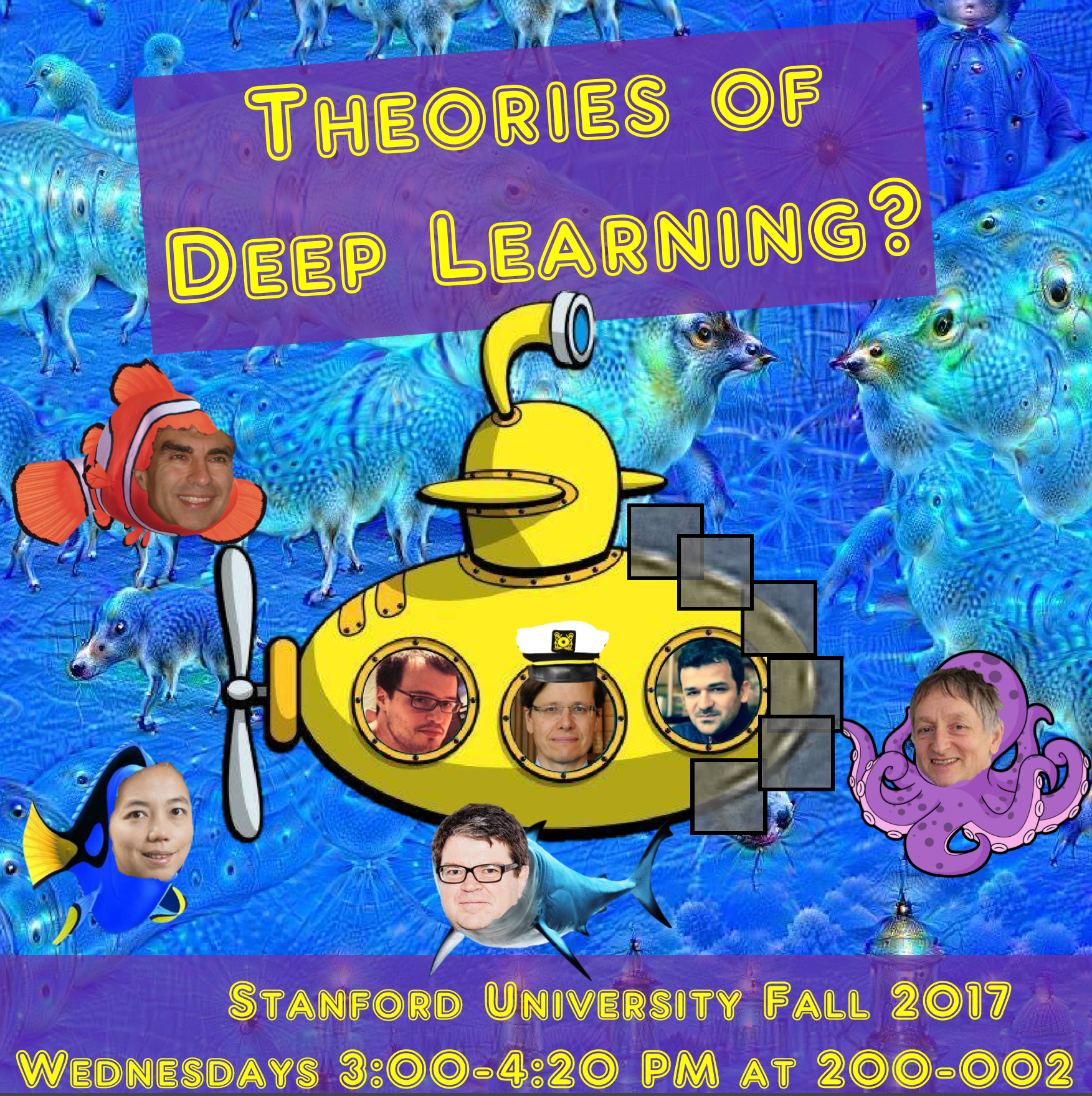
Theories of Deep Learning, videos and slides

With a little sense of provocations carried by the poster, Stanford university STATS 385 (Fall 2017) proposes a series of talks on the Theories of Deep Learning, with deep learning videos, lecture slides, and a  cheat sheet (stuff that everyone needs to know).  Outside the yellow submarine, Nemo-like sea creatures depict Fei-Fei Li, Yoshua Bengio, Geoffrey Hinton, Yann LeCun on a Deep dream background. So, wrapping up stuff about CNN (convolutional neural networks):

The spectacular recent successes of deep learning are purely empirical. Nevertheless intellectuals always try to explain important developments theoretically. In this literature course we will review recent work of Bruna and Mallat, Mhaskar and Poggio, Papyan and Elad, Bolcskei and co-authors, Baraniuk and co-authors, and others, seeking to build theoretical frameworks deriving deep networks as consequences. After initial background lectures, we will have some of the authors presenting lectures on specific papers. This course meets once weekly.
Videos and slides are gathered at follows.
  1. Theories of Deep Learning, Lecture 01: Deep Learning Challenge. Is There Theory? (Donoho/Monajemi/Papyan) : video, slides
  2. Theories of Deep Learning, Lecture 02: Overview of Deep Learning From a Practical Point of View (Donoho/Monajemi/Papyan) : video, slides
  3. Theories of Deep Learning, Lecture 03: Harmonic Analysis of Deep Convolutional Neural Networks (Helmut Bolcskei) : video, slides
  4. Theories of Deep Learning, Lecture 04: Convnets from First Principles: Generative Models, Dynamic Programming & EM (Ankit Patel) : video, slides
  5. Theories of Deep Learning, Lecture 05: When Can Deep Networks Avoid the Curse of Dimensionality and Other Theoretical Puzzles (Tomaso Poggio) : video, slides
  6. Theories of Deep Learning, Lecture 06: Views of Deep Networks from Reproducing Kernel Hilbert Spaces (Zaid Harchaoui) : video, slides
  7. Theories of Deep Learning, Lecture 07: Understanding and Improving Deep Learning With Random Matrix Theory (Jeffrey Pennington) : video, slides
  8. Theories of Deep Learning, Lecture 08: Topology and Geometry of Half-Rectified Network Optimization (Joan Bruna) : video, slides
  9. Theories of Deep Learning, Lecture 09: What’s Missing from Deep Learning? (Bruno Olshausen) : video, slides
  10. Theories of Deep Learning, Lecture 10: Convolutional Neural Networks in View of Sparse Coding (Vardan Papyan and David Donoho) : video, slides


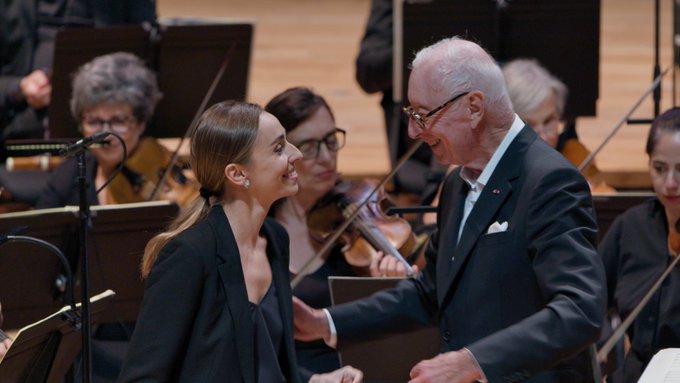
Film-opéra-concert Ariodante

  #Ariodante de #Händel par les Arts Florissants  en opéra-concert-film est #amazing ; trois raisons, deux futiles.  c'est 16 euros, ...