Showing posts with label seismic. Show all posts

September 29, 2014

Geophysics: Taking signal and noise to new dimensions


The journal (from SEG: Society of Exploration Geophysicists) Geophysics (SCImago journal ranking) has issued a call for papers for a special issue devoted to signal processing ("Taking signal and noise to new dimensions"), deadline end January 2015.
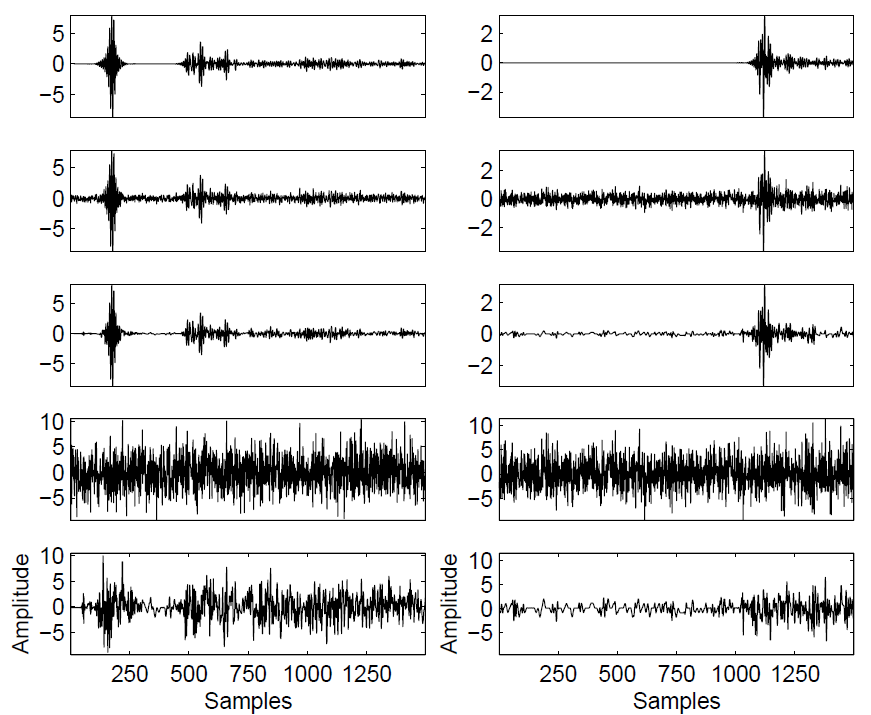
Original seismic stack
Large Gaussian noise corruption
Denoised with dual-tree wavelets

Taking signal and noise to new dimensions


Scope:  
The inherent complexity of seismic data has sparked, since about half a century, the development of innovative techniques to separate signal and noise. Localized time-scale representations (e. g. wavelets), parsimonious deconvolution, sparsity-promoted restoration and reconstruction are now at the core of modern signal processing and image analysis algorithms. Together with advances from computer science and machine learning, they shaped the field of data science, aiming at retrieving the inside structure of feature-rich, complex and high-dimensional datasets. This special issue is devoted to novel methodologies and strategies capable of tackling the large data volumes necessary to harness the future of subsurface exploration. A common trait resides in the possibility to seize at the same time both signal and noise properties along lower dimensional spaces, with dedicated metrics, to allow their joint use for seismic information enhancement. The traditional frontier between signal and noise is dimming, as incoherent seismic perturbations and formerly detrimental coherent wavefields, such as multiple reflections, are nowadays recognized as additional information for seismic processing, imaging and interpretation. We welcome contribution pertaining (but not limited) to:
  • emerging seismic data acquisition and management technologies
  • more compact, sparser and optimized multidimensional seismic data representations
  • filtering, noise attenuation, signal enhancement and source separation
  • advanced optimization methods and related metrics, regularizations and penalizations
  • artificial intelligence and machine learning applications for seismic data characterization
  • novel applications of signal and image processing to geophysics
  • hardware and software algorithmic breakthroughs
Timeline (tentative) for the Geophysics call of papers
  • Submission deadline: 31 Jan 2015
  • Peer review complete: 10 July 2015
  • All files submitted for production: 15 August 2015
  • Publication of issue: November-December 2015

Gravity survey @ LandTech

    May 30, 2014

    Sparse template-based adaptive filtering

    Significance index related to Student's t-test
    The phenomenon arises in several real-life signal processing contexts: acoustic echo-cancellation (AEC) in sound and speech,  non-destructive testing where transmitted waves may rebound at material interfaces (e.g. ultrasounds), or pattern matching in images. Here in seismic reflection or seismology. Weak signals (of interest) are buried under both strong random and structured noise. Provided appropriate templates are obtained, we propose a structured-pattern filtering algorithm (called Ricochet) through constrained adaptive filtering in a  transformed domain. Its generic methodology impose sparsity: in different wavelet frames (Haar, Daubechies, Symmlets) coefficients, using the L-1 or Manhattan norm, as well as on adaptive filter coefficients using concentration measures (for sparser filters in the time domain): L-1, the Frobenius norm squared, and the mixed L-1,2 norms). Regularity properties are constrained as well, for instance slow variation on the adaptive filter coefficients (uniform, Chebychev or L-infinity norm). Quantitative results are given with a significance index, reminiscent of the Student t-test.


    Abstract: Unveiling meaningful geophysical information from seismic data requires to deal with both random and structured ``noises''. As their amplitude may be greater than signals of interest
    Seismic data: primaries and multiples
    Lost in multiples: a creeping primary (flat, bootom-right)
    (primaries), additional prior information is especially important in performing efficient signal separation. We address here the problem of multiple reflections, caused by  wave-field bouncing between layers. Since only approximate models of these phenomena are available, we propose a flexible framework for time-varying adaptive filtering of seismic signals, using sparse representations,  based on inaccurate templates. We recast the joint estimation of adaptive filters and primaries in a new convex variational formulation. This approach allows us to incorporate plausible knowledge about noise statistics, data sparsity and slow filter variation in parsimony-promoting wavelet frames.  The designed primal-dual algorithm solves a  constrained  minimization problem that alleviates standard regularization issues in finding hyper-parameters. The approach demonstrates  significantly good performance in low signal-to-noise ratio conditions, both for simulated and real field seismic data.

    All the metrics here are convex. Wait a bit for something completely different with non-convex penalties, namely smoothed versions of the ratio of the L1 norm over the L2 norm: Euclid in a Taxicab: Sparse Blind Deconvolution with Smoothed $\ell_1/ell_2$ Regularization, covered in Nuit Blanche, and with arxiv page and pdf.

    May 27, 2014

    Postdoc position: Very large data management in Geosciences


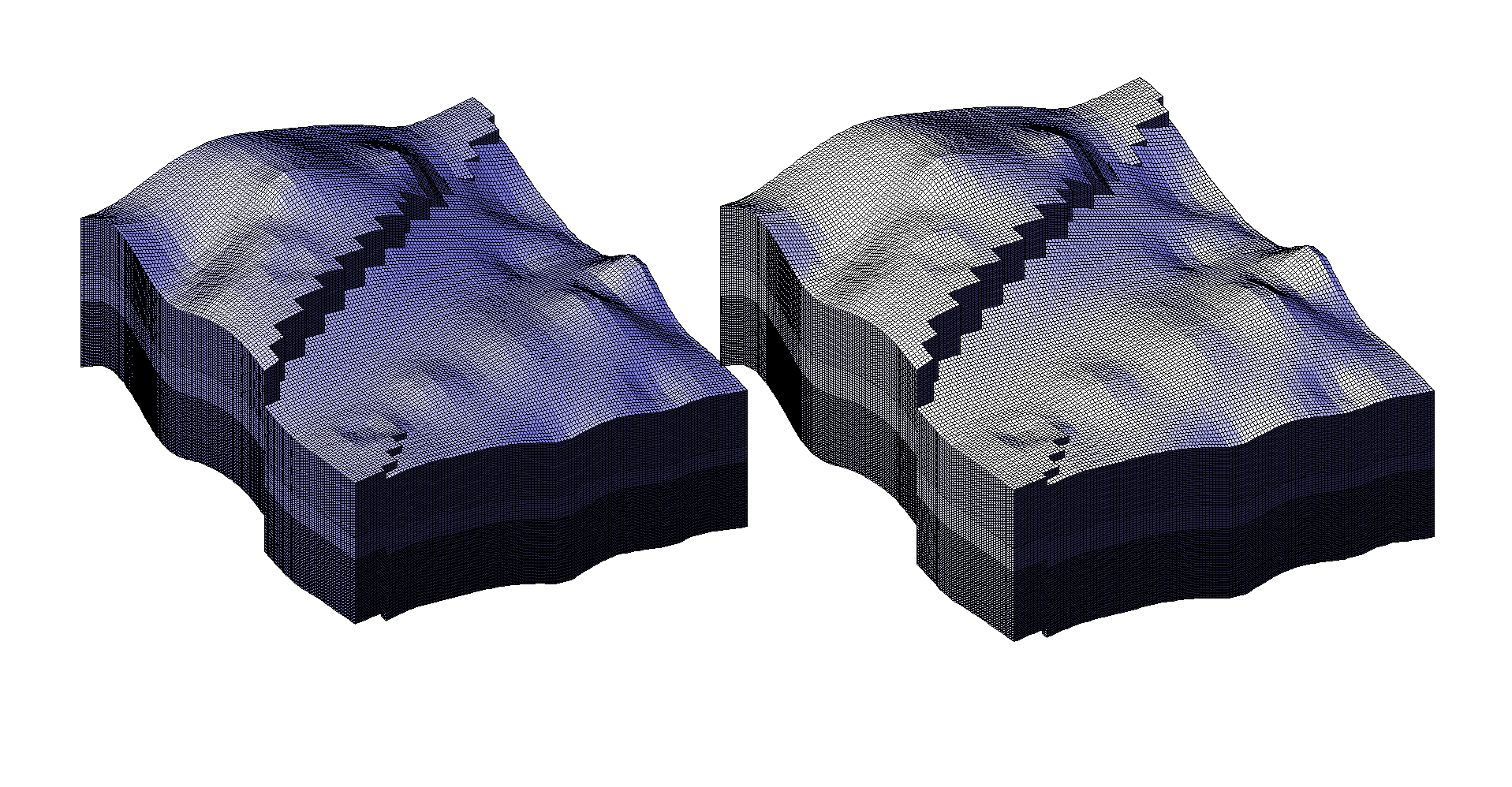
    Geophysical mesh at two resolutions
    [UPDATE: 2014/09/21 Position filled]

    So we (IFPEN) have a postdoc position on "Very large data management in Geosciences" (gestion des très gros volumes de données en géosciences), with details at: 

    Abstract: The main purpose of the post-doctoral work is to propose new data compression techniques for volumetric meshes able to manage seismic data values attached to geometry elements (nodes or cells) with adaptive decompression for post-processing functionalities (visualization). Compression algorithms adapted to "big data" will enable our current software scalability, for instance, geoscience fluid-flow simulation or transport combustion simulation on very large meshes. Obtained results are intended to contribute to IFPEN scientific lock about very large data management with a target of being able to process billion of cells or data samples. Results will also be used to propose new software solutions for the storage, the transfer and the processing (exploration, visualization) of these large data sets.
    Résumé : L'objectif de ce post-doctorat est de proposer de nouvelles méthodes de compression de données
    Seismic data compression and denoising
    et de maillages volumiques capables de gérer des propriétés attachées à la géométrique (connexité de mailles, groupes spatiaux de traces sismiques), éventuellement évolutives, tout en permettant une décompression progressive et adaptée à la visualisation et au traitement. Les algorithmes de compression pour les données volumiques permettraient de les exploiter dans les outils logiciels qui manipulent des ensembles volumineux (simulation d'écoulement poreux en géosciences ou simulation de combustion en transport). Les résultats obtenus auront vocation à contribuer au verrou technologique concernant les très gros volumes de données avec une cible fixée sur le milliard de cellules ou d'échantillons. Les résultats seront notamment exploités pour assurer le stockage, le transfert mais aussi la manipulation (exploration, visualisation) de ces très gros volumes.

    December 17, 2013

    A Primal-Dual Proximal Algorithm for Sparse Template-Based Adaptive Filtering: Application to Seismic Multiple Removal

    A year ago we talked about a technique for Adaptive multiple subtraction with wavelet-based complex unary Wiener filters. The field of application is seismic signal processing. The fast and simple design was heuristic (helping discovery, stimulating interest as a means of furthering investigation.based on experimentation), based on an appropriate combination of "a sparsifying transform" and a closed-form one-tap, sliding-window adaptive filter. To make it more pragmatic (based on observation and real-world models), an alternative approach uses proximal algorithms to incorporate sparsity priors, either on data in redundant frame transforms and in the short-support filter design. Here is the preprint: A Primal-Dual Proximal Algorithm for Sparse Template-Based Adaptive Filtering: Application to Seismic Multiple Removal and the version published by IEEE Transactions on Signal Processing.

    Unveiling meaningful geophysical information from seismic data requires to deal with both random and structured ``noises''. As their amplitude may be greater than signals of interest (primaries), additional prior information is especially important in performing efficient signal separation. We address here the problem of multiple reflections, caused by  wave-field bouncing between layers. Since only approximate models of these phenomena are available, we propose a flexible framework for time-varying adaptive filtering of seismic signals, using sparse representations,  based on inaccurate templates. We recast the joint estimation of adaptive filters and primaries in a new convex variational formulation. This approach allows us to incorporate plausible knowledge about noise statistics, data sparsity and slow filter variation in parsimony-promoting wavelet frames.  The designed primal-dual algorithm solves a  constrained  minimization problem that alleviates standard regularization issues in finding hyperparameters. The approach demonstrates  significantly good performance in low signal-to-noise ratio conditions, both for simulated and real field data.
    While applied here to seismic signal, the concept is heavily related to pattern matching in images, echo cancellation in audio or voice signals, exemplar search in speech.

    Film-opéra-concert Ariodante

      #Ariodante de #Händel par les Arts Florissants  en opéra-concert-film est #amazing ; trois raisons, deux futiles.  c'est 16 euros, ...