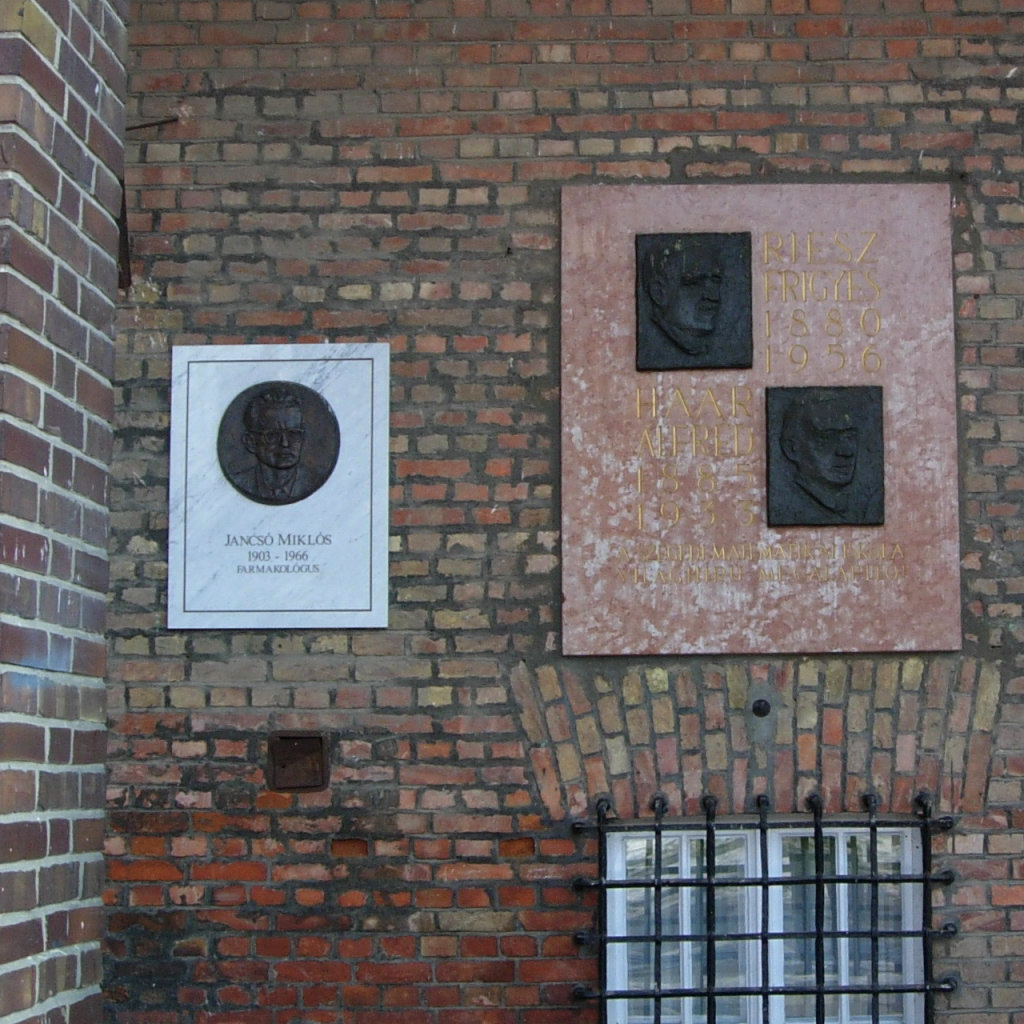
Under the cryptic title dwells a nice invitation by Vincent Mazet to give a talk on a panorama of 2D wavelets at iCube-MIV : modèles, images et vision (Strasbourg University). Although the abstract is in french, slides are globish. For those who have an eye for finest details, Alfréd Haar and Frigyes Riesz, two prominent functional analysis and therefore wavelet contributors (albeit indirectly) are honored on this memorial at Szeged university.
Vendredi 15 mars 2013, 10h30, A301, séminaire commun D-IRTS & École doctorale MSII
Ondelettes et autres représentations bidimensionnelles, multi-échelles et géométriques pour le traitement d'images : un panorama
Conférencier : Laurent Duval (IFP Energies nouvelles), avec Laurent Jacques, Caroline Chaux et Gabriel Peyré
Résumé : La quête de représentations optimales en traitement d'images et vision par ordinateur se heurte à la richesse et la diversité des données bidimensionnelles. De nombreux travaux se sont cependant attelés aux tâches de séparation de zones régulières, de contours et de textures, à la recherche d'un compromis entre complexité et efficacité de représentation. La prise en compte des aspects multi-échelles, dans le siècle de l'invention des ondelettes, a joué pour l'analyse d'images un rôle important. La dernière décennie a ainsi vu apparaître une série de méthodes efficaces, combinant des aspects multi-échelle à des aspects directionnels et fréquentiels, permettant de mieux prendre en compte l'orientation des éléments d'intérêt des images (curvelets, contourlets et autres shearlets). Leur fréquente redondance leur permet d'obtenir des représentations plus parcimonieuses et parfois quasi-invariantes pour certaines transformations usuelles (translation, rotation). Ces méthodes sont la motivation d'une revue thématique, incluant quelques incursions sur des domaines non-euclidiens (sphère, maillages, graphes).
Abstract: The richness of natural images makes the quest for optimal representations in image processing and computer vision challenging. The latter observation has not prevented the design of image representations, which trade off between efficiency and complexity, while achieving accurate rendering of smooth regions as well as reproducing faithful contours and textures. The most recent ones, proposed in the past decade, share a hybrid heritage highlighting the multiscale and oriented nature of edges and patterns in images. This paper presents a panorama of the aforementioned literature on decompositions in multiscale, multi-orientation bases or dictionaries. They typically exhibit redundancy to improve sparsity in the transformed domain and sometimes its invariance with respect to simple geometric deformations (translation, rotation). Oriented multiscale dictionaries extend traditional wavelet processing and may offer rotation invariance. Highly redundant dictionaries require specific algorithms to simplify the search for an efficient (sparse) representation. We also discuss the extension of multiscale geometric decompositions to non-Euclidean domains such as the sphere or arbitrary meshed surfaces. The etymology of panorama suggests an overview, based on a choice of partially overlapping “pictures”. We hope that this paper will contribute to the appreciation and apprehension of a stream of current research directions in image understanding.
L. Jacques, L. Duval, C. Chaux, G. Peyré, "A panorama on multiscale geometric representations, intertwining spatial, directional and frequency selectivity", Signal Processing, volume 91, number 12, December 2011, pages 2699-2730.
Slides
http://icube-miv.unistra.fr/fr/index.php?title=Fichier:Duval-20130315.pdf&page=1
http://www.laurent-duval.eu/Articles/Duval_L_20130315_lect_panorama-wavelet-multiscale-representations-ICube.pdf
Other advances in Multirate Filter Bank Structures and Multiscale Representations are devoted a Special issue in Signal Processing, Dec. 2011.