Showing posts with label scattering networks. Show all posts

January 15, 2018

Theories of Deep Learning, videos and slides

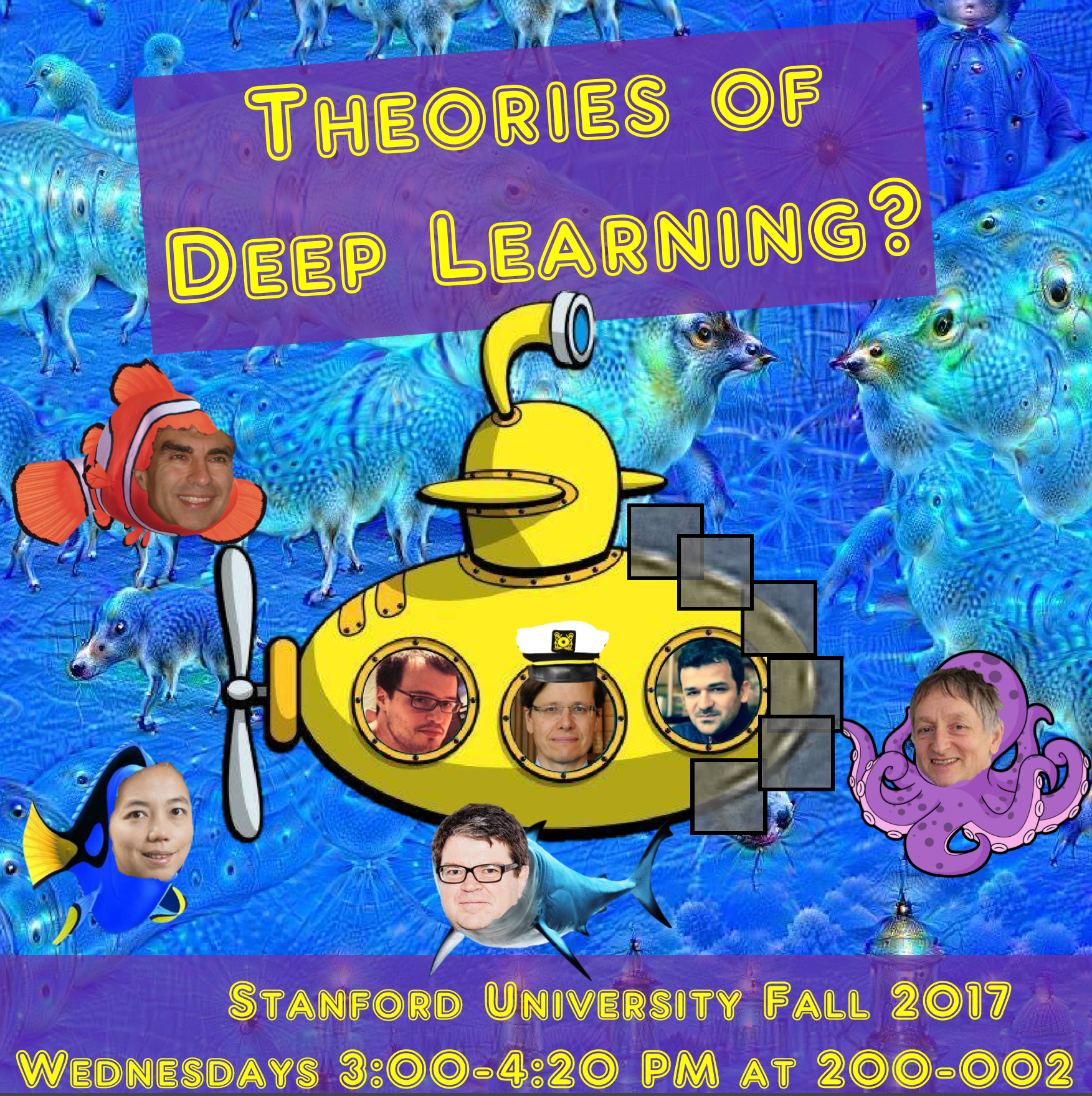
With a little sense of provocations carried by the poster, Stanford university STATS 385 (Fall 2017) proposes a series of talks on the Theories of Deep Learning, with deep learning videos, lecture slides, and a  cheat sheet (stuff that everyone needs to know).  Outside the yellow submarine, Nemo-like sea creatures depict Fei-Fei Li, Yoshua Bengio, Geoffrey Hinton, Yann LeCun on a Deep dream background. So, wrapping up stuff about CNN (convolutional neural networks):

The spectacular recent successes of deep learning are purely empirical. Nevertheless intellectuals always try to explain important developments theoretically. In this literature course we will review recent work of Bruna and Mallat, Mhaskar and Poggio, Papyan and Elad, Bolcskei and co-authors, Baraniuk and co-authors, and others, seeking to build theoretical frameworks deriving deep networks as consequences. After initial background lectures, we will have some of the authors presenting lectures on specific papers. This course meets once weekly.
Videos and slides are gathered at follows.
  1. Theories of Deep Learning, Lecture 01: Deep Learning Challenge. Is There Theory? (Donoho/Monajemi/Papyan) : video, slides
  2. Theories of Deep Learning, Lecture 02: Overview of Deep Learning From a Practical Point of View (Donoho/Monajemi/Papyan) : video, slides
  3. Theories of Deep Learning, Lecture 03: Harmonic Analysis of Deep Convolutional Neural Networks (Helmut Bolcskei) : video, slides
  4. Theories of Deep Learning, Lecture 04: Convnets from First Principles: Generative Models, Dynamic Programming & EM (Ankit Patel) : video, slides
  5. Theories of Deep Learning, Lecture 05: When Can Deep Networks Avoid the Curse of Dimensionality and Other Theoretical Puzzles (Tomaso Poggio) : video, slides
  6. Theories of Deep Learning, Lecture 06: Views of Deep Networks from Reproducing Kernel Hilbert Spaces (Zaid Harchaoui) : video, slides
  7. Theories of Deep Learning, Lecture 07: Understanding and Improving Deep Learning With Random Matrix Theory (Jeffrey Pennington) : video, slides
  8. Theories of Deep Learning, Lecture 08: Topology and Geometry of Half-Rectified Network Optimization (Joan Bruna) : video, slides
  9. Theories of Deep Learning, Lecture 09: What’s Missing from Deep Learning? (Bruno Olshausen) : video, slides
  10. Theories of Deep Learning, Lecture 10: Convolutional Neural Networks in View of Sparse Coding (Vardan Papyan and David Donoho) : video, slides

December 20, 2014

Learning meets compression: small-data-science internship (IFPEN)


Internship subject: [french/english]
Many experimental designs acquire continuous or salve signals or images. Those are characteristic of a specific phenomenon. One may find examples at IFPEN in seismic data/images, NDT/NDE acoustic emissions (corrosion, battery diagnosis) engine benches (cylinder pressure data, fast camera), high-thoughput screening in chemistry. Very often, such data is analyzed with standardized, a priori indices. Comparisons between different experiments (difference- or classification-based) are often based on the same indices, without resorting to initial measurements.

The increasing data volume, the variability in sensor and sampling, the possibility of different pre-processing yield two problems: the management and access to data (« big data ») and their optimal exploitation by dimension reduction methods, supervised or unsupervised learning (« data science »). This project aims at the analysis of the possibility of a joint compressed representation of data and the extraction of pertinent indicators, at different characteristic scales, and the relative impact of the first aspect (lossy compression degradation) over the second aspect (precision and robustness of extracted feature indicators).

The internship possesses a dual goal. The first aspect will be dealing with scientific research on sparse signal/image representations with convolution networks based on multiscale wavelet techniques, called scattering networks. Their descriptors (or footprints) possess fine translation, rotation and scale invariance. Those descriptors will be employed for classification and detection. The second aspect will carry on the impact of lossy compression on the preceeding results, and the development of novel sparse representations for joint compression and learning.

J. Bruna, S. Mallat. Invariant scattering convolution networks. IEEE Trans. on Patt. Anal. and Mach. Int., 2010
L. Jacques, L. Duval, C. Chaux, G. Peyré, A Panorama on Multiscale Geometric Representations, Intertwining Spatial, Directional and Frequency Selectivity, Signal Processing, 2011
C. Couprie, C. Farabet, L. Najman, Y. LeCun, Convolutional Nets and Watershed Cuts for Real-Time Semantic Labeling of RGBD Videos, Journal of Machine Learning Research, 2014

A PhD thesis (Characteristic fingerprint computation and storage for high-throughput data flows and their on-line analysis, with J.-C. Pesquet, Univ. Paris-Est) is proposed, starting September 2015.

Information update: http://www.laurent-duval.eu/lcd-2015-intern-learning-compression.html

Film-opéra-concert Ariodante

  #Ariodante de #Händel par les Arts Florissants  en opéra-concert-film est #amazing ; trois raisons, deux futiles.  c'est 16 euros, ...