Showing posts with label shearlet. Show all posts

March 23, 2013

W2 4 i3 (2D wavelets for iCube)

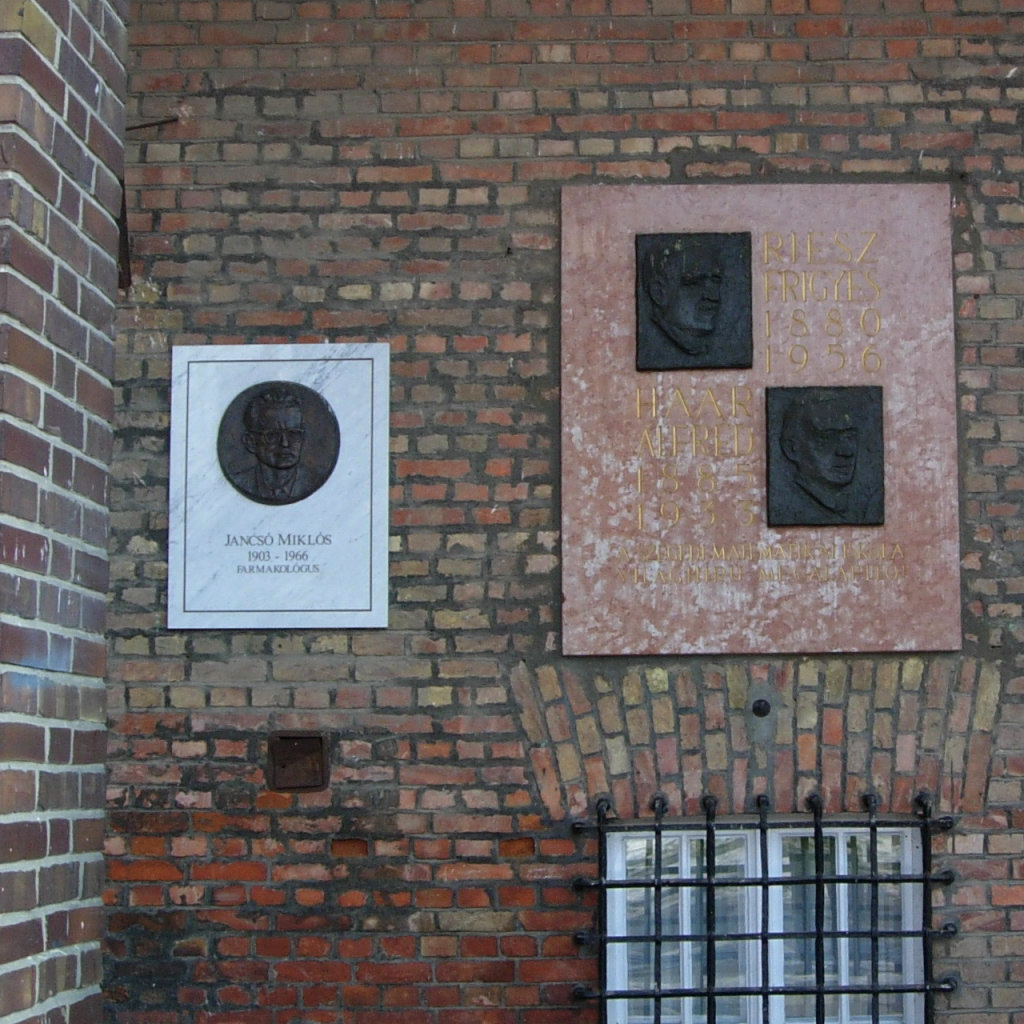
Under the cryptic title dwells a nice invitation by Vincent Mazet to give a talk on a panorama of 2D wavelets at iCube-MIV : modèles, images et vision (Strasbourg University). Although the abstract is in french, slides are globish. For those who have an eye for finest details, Alfréd Haar and Frigyes Riesz, two prominent functional analysis and therefore wavelet contributors (albeit indirectly) are honored on this memorial at Szeged university.
Vendredi 15 mars 2013, 10h30, A301, séminaire commun D-IRTS & École doctorale MSII
Ondelettes et autres représentations bidimensionnelles, multi-échelles et géométriques pour le traitement d'images : un panorama

Conférencier : Laurent Duval (IFP Energies nouvelles), avec Laurent Jacques, Caroline Chaux et Gabriel Peyré

Résumé : La quête de représentations optimales en traitement d'images et vision par ordinateur se heurte à la richesse et la diversité des données bidimensionnelles. De nombreux travaux se sont cependant attelés aux tâches de séparation de zones régulières, de contours et de textures, à la recherche d'un compromis entre complexité et efficacité de représentation. La prise en compte des aspects multi-échelles, dans le siècle de l'invention des ondelettes, a joué pour l'analyse d'images un rôle important. La dernière décennie a ainsi vu apparaître une série de méthodes efficaces, combinant des aspects multi-échelle à des aspects directionnels et fréquentiels, permettant de mieux prendre en compte l'orientation des éléments d'intérêt des images (curvelets, contourlets et autres shearlets). Leur fréquente redondance leur permet d'obtenir des représentations plus parcimonieuses et parfois quasi-invariantes pour certaines transformations usuelles (translation, rotation). Ces méthodes sont la motivation d'une revue thématique, incluant quelques incursions sur des domaines non-euclidiens (sphère, maillages, graphes).

Abstract: The richness of natural images makes the quest for optimal representations in image processing and computer vision challenging. The latter observation has not prevented the design of image representations, which trade off between efficiency and complexity, while achieving accurate rendering of smooth regions as well as reproducing faithful contours and textures. The most recent ones, proposed in the past decade, share a hybrid heritage highlighting the multiscale and oriented nature of edges and patterns in images. This paper presents a panorama of the aforementioned literature on decompositions in multiscale, multi-orientation bases or dictionaries. They typically exhibit redundancy to improve sparsity in the transformed domain and sometimes its invariance with respect to simple geometric deformations (translation, rotation). Oriented multiscale dictionaries extend traditional wavelet processing and may offer rotation invariance. Highly redundant dictionaries require specific algorithms to simplify the search for an efficient (sparse) representation. We also discuss the extension of multiscale geometric decompositions to non-Euclidean domains such as the sphere or arbitrary meshed surfaces. The etymology of panorama suggests an overview, based on a choice of partially overlapping “pictures”. We hope that this paper will contribute to the appreciation and apprehension of a stream of current research directions in image understanding.

L. Jacques, L. Duval, C. Chaux, G. Peyré, "A panorama on multiscale geometric representations, intertwining spatial, directional and frequency selectivity", Signal Processing, volume 91, number 12, December 2011, pages 2699-2730.

Slides
http://icube-miv.unistra.fr/fr/index.php?title=Fichier:Duval-20130315.pdf&page=1
http://www.laurent-duval.eu/Articles/Duval_L_20130315_lect_panorama-wavelet-multiscale-representations-ICube.pdf

April 22, 2012

Hyperbolets (on WITS: Where is the Starlet)

A new conference is born: UCCV 2013, The 1st IEEE Workshop on User-Centred Computer Vision, due in Florida, Tampa. on January 2013. It has been added to SIVA Conferences.

While the shearlets are enjoying some spread (cf. Shearlets from MIA 2012 or this paper), some of their contributors are involved in hyperbolets, or hyperbolic wavelets, closely related cousins. Here they are (as on WITS: where is the Starlet):

Hyperbolets

In short: An example of multi-composite wavelets with hyperbolic scaling law
Etymology: From the hyperbola (wiki entry), with a potential reference (article no available on 2011/05/26) to the parabolic scaling law of the shearlets
Origin: Glenn R. Easley, Demetrio Labate, Vishal M. Patel: Multi-composite wavelet estimation, Proceedings of SPIE Volume 8138, Wavelets and Sparsity XIV, Aug. 2011 (local copy)
Abstract: In this work, we present a new approach to image denoising by using a general representation known as wavelets with composite dilations. These representations allow for waveforms to be defined not only at various scales and locations but also at various orientations. For this talk, we present many new representations such as hyperbolets and propose combining multiple estimates from various representations to form a unique denoised image. In particular, we can take advantage of different representations to sparsely represent important features such as edges and texture independently and then use these estimates to derive an improved estimate.
The hyperbolet construction is further refined in:
G. R. Easley, D. Labate and V. M. Patel, Hyperbolic shearlets, IEEE International Conference on Image Processing (ICIP), Orlando, FL, 2012, submitted (local copy)
G. R. Easley, D. Labate, and V. M. Patel, Directional multiscale processing of images using wavelets with composite dilations, submitted 2011 (local copy)
Contributors: Glenn R. Easley (no personal page), Demetrio Labate, Vishal M. Patel
Some properties:
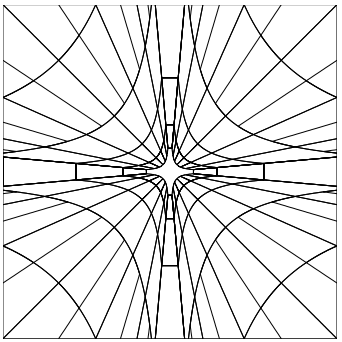
hyperbolet frequency plane

Tiling of the frequency domain associated with an hyperbolic system of wavelets with composite dilations.
Closely related to shearlets
Anecdote:
Usage:
See also: The above work might be related to Glenn R. Easley, Demetrio Labate: Critically Sampled Wavelets with Composite Dilations (local copy), preprint, 2011, which develops interesting critically sampled directional wavelet schemes (DWTShear, CShear, QDWTShear)
Comments:

More on the topic:
2D wavelets: A panorama on multiscale geometric representations, intertwining spatial, directional and frequency selectivity

March 6, 2012

WITS: Shearlets from MIA 2012


At the wonderful MIA 2012 (hey Gabriel, did i tell you how that was great?), two talks have been devoted to shearlets (Gitta Kutyniok, Gabriele Steidl), yet another geometric multiscale representation for images. And a brand new Matlab toolbox from Gabriele Steidl group named FFST (fast finite shearlet transform) and developed by Sören Haüser has been announced.

Shearlet-Zerlegung eines Auges.© Gitta Kutyniok


A good opportunity to update a little corner of WITS: Where is the Starlet, which was beginning to grow a few webs. Mmh, look like some familiar frequency domain partitioning... And now for something completely different: number 1, the shearlet... the shearlet! (Monty Python inside)


Shearlets
In short: Non-separable wavelets built out of parabolic scaling, shear, and translation operations
Etymology: From shear, a sheer distorsion
Origin: Labate, Demetrio and Lim, W-Q. and Kutyniok, Gitta and Weiss Guido, Sparse multidimensional representation using shearlets (local copy) A handful lot of papers is available here: shearlet papers. A first overview is given in Shearlets. The First Five Year (Oberwolfach Report, 2010, local copy).


Some properties: Unlike curvelets, shearlets form an affine system with a single generating mother shearlet function parameterized by a scaling, a shear, and a translation parameter. Provides the same approximation properties as curvelets, albeit with a different directional sensitivity. Exist in band-limited or compact support flavors. Possess natural, canonical smoothness spaces, called shearlet coorbit spaces, similar to Besov spaces for wavelets. Apparently extend to arbitrary any dimensions.


Usage: Image denoising, restoration, morphological component analysis
See also: The shearlet website, recently updated with ShearLab (... a rationally designed digital shearlet transform) For discrete implementation, there exists for instance a Digital Shearlet Transforms or Development of a Digital Shearlet Transform Based on Pseudo-Polar FFT. Shearlet Matlab toolboxes are available at ShearLab matlab toolboxes, local shearlet toolbox by G. Easley and FSST:
Comments: Potential a hard competitor, for years to come, to the quite oversold curvelets (IMHOlet: In My (little) Humble Opinion)


More on the topic:
2D wavelets: A panorama on multiscale geometric representations, intertwining spatial, directional and frequency selectivity

Film-opéra-concert Ariodante

  #Ariodante de #Händel par les Arts Florissants  en opéra-concert-film est #amazing ; trois raisons, deux futiles.  c'est 16 euros, ...