Showing posts with label image processing. Show all posts

April 30, 2016

Trainlets: cropped wavelet decomposition for high-dimensional learning

It's being a lonng time: element 120 from the aperiodic table of wavelets is the trainlet, from Jeremias Sulam, Student Member, Boaz Ophir, Michael Zibulevsky, and Michael Elad, Trainlets: Dictionary Learning in High Dimensions:
Abstract: Sparse representations has shown to be a very powerful model for real world signals, and has enabled the development of applications with notable performance. Combined with the ability to learn a dictionary from signal examples, sparsity-inspired algorithms are often achieving state-of-the-art results in a wide variety of tasks. Yet, these methods have traditionally been restricted to small dimensions mainly due to the computational constraints that the dictionary learning problem entails. In the context of image processing, this implies handling small image patches. In this work we show how to efficiently handle bigger dimensions and go beyond the small patches in sparsity-based signal and image processing methods. We build our approach based on a new cropped wavelet decomposition, which enables a multi-scale analysis with virtually no border effects. We then employ this as the base dictionary within a double sparsity model to enable the training of adaptive dictionaries. To cope with the increase of training data, while at the same time improving the training performance, we present an Online Sparse Dictionary Learning (OSDL) algorithm to train this model effectively, enabling it to handle millions of examples. This work shows that dictionary learning can be up-scaled to tackle a new level of signal dimensions, obtaining large adaptable atoms that we call trainlets.
They offer a base dictionary used within a double sparsity model to enable the training of adaptive dictionaries. The associated package is here, from Michael Elad software page.  The  cropped wavelet decomposition enables a multi-scale analysis with virtually no border effects. An entry  to trainlets has added to WITS, the aperiodic table of wavelets.

But things always ends up with a song! Two of my favorite train songs, by  Porcupine tree (Trains) and the Nits (The train).


November 10, 2015

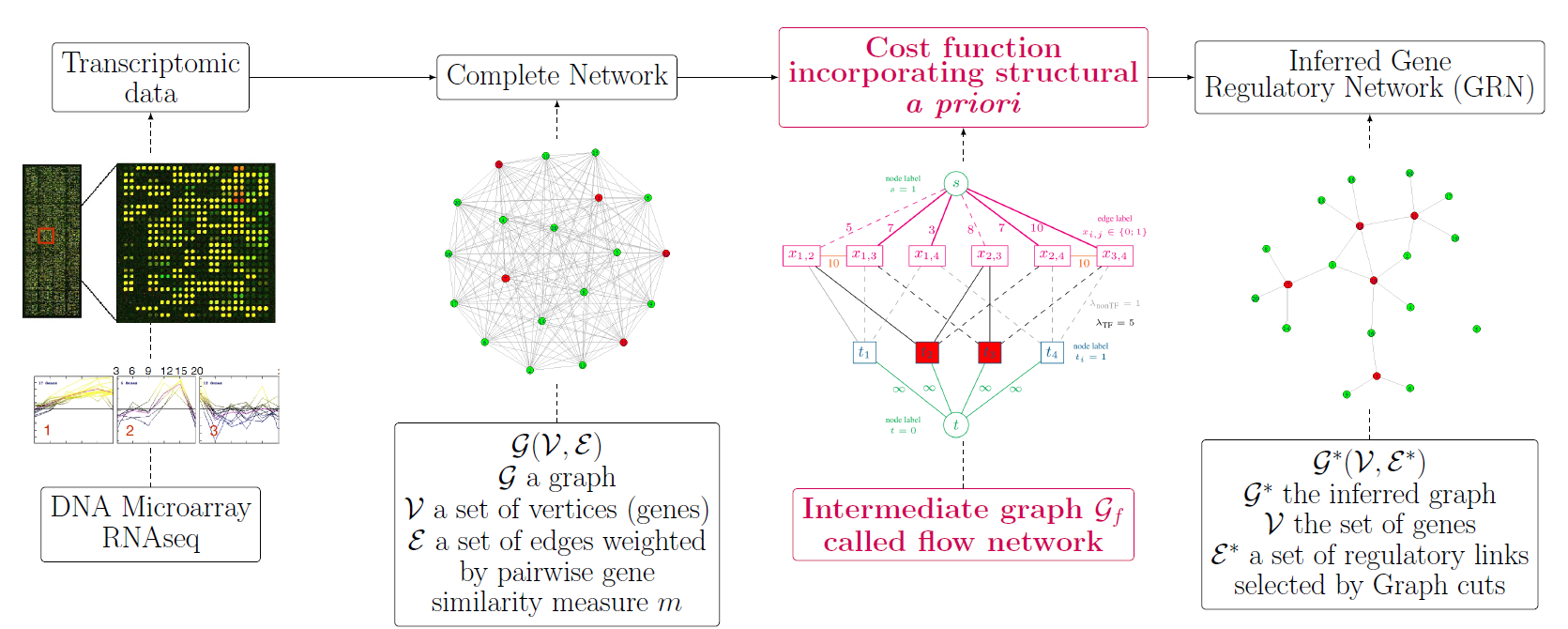
BRANE Cut: Biologically-Related Apriori Network Enhancement with Graph cuts

[BRANE Cut featured on RNA-Seq blog][Omic tools][bioRxiv preprint][PubMed/Biomed Central][BRANE Cut code][BRANE Omics]

Gene regulatory networks are somehow difficult to infer. This first work from an on-going work on BRANE Omics (termed BRANE *, for Biologically Related Apriori Netwok Enhancement) introduces an optimization method (based on Graph cuts, borrowed from computer vision/image processing) to infer graphs based on biologically-related a priori (including sparsity). It is succesfully tested on DREAM challenge data and an Escherichia coli network, with a specific work to derive optimization parameters from gene network cardinality properties. And it is quite fast.


Background: Inferring gene networks from high-throughput data constitutes an important step in the discovery of relevant regulatory relationships in organism cells. Despite the large number of available Gene Regulatory Network inference methods, the problem remains challenging: the underdetermination in the space of possible solutions requires additional constraints that incorporate a priori information on gene interactions.

Methods: Weighting all possible pairwise gene relationships by a probability of edge presence, we formulate the regulatory network inference as a discrete variational problem on graphs. We enforce biologically plausible coupling between groups and types of genes by minimizing an edge labeling functional coding for a priori structures. The optimization is carried out with Graph cuts, an approach popular in image processing and computer vision. We compare the inferred regulatory networks to results achieved by the mutual-information-based Context Likelihood of Relatedness (CLR) method and by the state-of-the-art GENIE3, winner of the DREAM4 multifactorial challenge.
Results

Our BRANE Cut approach infers more accurately the five DREAM4 in silico networks (with improvements from 6 % to 11 %). On a real Escherichia coli compendium, an improvement of 11.8 % compared to CLR and 3 % compared to GENIE3 is obtained in terms of Area Under Precision-Recall curve. Up to 48 additional verified interactions are obtained over GENIE3 for a given precision. On this dataset involving 4345 genes, our method achieves a performance similar to that of GENIE3, while being more than seven times faster. The BRANE Cut code is available at: http://​www-syscom.​univ-mlv.​fr/~pirayre/Codes-GRN-BRANE-cut.html.

Conclusions: BRANE Cut is a weighted graph thresholding method. Using biologically sound penalties and data-driven parameters, it improves three state-of-the art GRN inference methods. It is applicable as a generic network inference post-processing, due to its computational efficiency.
Keywords:  Network inference, Reverse engineering, Discrete optimization, Graph cuts, Gene expression data, DREAM challenge.

Additional information of the BRANE Power page


September 13, 2014

Cours : Radial basis functions

Un message d'Albert Cohen annonce un mini-cours : "Interpolation et Quasi-Interpolation utilisant les fonctions radiales comme méthode d'approximation de plusieurs variables"
Le professeur Martin Buhmann (Université de Justus-Liebig, Giessen), de l’Université de Giessen, fera le lundi 22 septembre au laboratoire J.L. Lions un mini-cours de 2h sur les bases de fonction radiales. Ces outils sont fréquement utilisés en approximation multivariée, en particulier en grande dimension, en statistiques (méthodes à noyaux), et parfois dans le traitement de l’image et l’approximation des EDP. Martin Buhmann est un expert reconnu dans ce domaine. Le cours aura lieu de 16:00 à 18:30 en salle 309 (salle de séminaire du LJLL) couloir 15-16, 3ème étage, Jussieu. 
Radial version of the Laplacian of a Gaussian wavelet

Le résumé (en français !)
Les méthodes utilisant les fonctions radiales sont des façons d'approcher une fonction par une combinaison linéaire (finie ou infinie) de translatées d'une unique fonction, appelée fonction noyau. Cette fonction peut avoir, par exemple, la forme d'une exponentielle (noyau de Gauss ou de Poisson). Les coefficients de cette combinaison linéaire étant choisis, par exemple, en fonction des conditions d'interpolation. Beaucoup de propriétés typiques de l'approximation par des noyaux de type fonctions radiales proviennent de la symétrie radiale de ces noyaux. Les avantages de cette méthode liée aux splines à une dimension sont, d'une part sa généralisation naturelle à une dimension quelconque (les fonctions noyaux étant générées à partir d'une fonction d'une variable multidimensionnelle composée avec une norme – lorsque la norme est euclidienne on parle de fonctions radiales) et d'autre part, ses propriétés de convergence très rapide si les fonctions approximées sont assez lisses (souvent en convergence spectrale). De plus, en utilisant un grand choix de fonctions radiales, le problème d'interpolation est bien défini avec une unique solution indépendante de la dimension de l'espace et de la distribution des points d'interpolation. Cette situation optimale serait impossible par exemple dans le cas des polynômes en plusieurs dimensions. Entre autres les noyaux de Gauss, les noyaux multiquadriques, inverse multiquadriques, les noyaux de Poisson, ..., ont cette propriété intéressante qui permet de nombreuses applications. Dans ces deux exposés nous introduirons le concept de fonction radiale, nous présenterons des propriétés de ces fonctions approximantes et nous détaillerons les théorèmes de convergence qui montrent la puissance des méthodes d'approximation utilisant cette idée.

Quelques pistes :
Yafer Abu-Mostafa, Learning from data, introductory machine learning course, Caltech, 2012, lecture 16, Radial Basis Functions


M. D. Buhmann : Radial basis function, Scholarpedia, 2010
M. D. Buhmann : Radial Basis Functions: Theory and Implementations, 2003, Cambridge University Press
J. B. Cherrie, R. K. Beatson, G. N.  Newsam,  Fast evaluation of radial basis functions: methods for generalised multiquadrics in R^n, SIAM Journal on Scientific Computation, 2002
M. D. Buhmann : Radial basis functions, Acta Numerica, 2000
Radial basis function methods are modern ways to approximate multivariate functions, especially in the absence of grid data. They have been known, tested and analysed for several years now and many positive properties have been identi ed. This paper gives a selective but up-to-date survey of several recent developments that explains their usefulness from the theoretical point of view and contributes useful new classes of radial basis function. We consider particularly the new results on convergence rates of interpolation with radial basis functions, as well as some of the various achievements on approximation on spheres, and the e cient numerical computation of interpolants for very large sets of data. Several examples of useful applications are stated at the end of the paper.
Mark J. L. Orr, Introduction to Radial Basis Function Networks, April 1996
D. H. Broomhead,  D. Lowe, Multivariable Functional Interpolation and Adaptive Networks, Complex Systems, 1988


May 10, 2014

Computational Harmonic Analysis: Winter School

This message was communicated to me by Caroline Chaux, to share:

Computational Harmonic Analysis: Winter School, Marseille, October 2014

We are pleased to announce the winter school on Computational Harmonic Analysis - with Applications to Signal and Image Processing, that will be held in October 2014 (20-24), in Marseille, France (at CIRM).

The topics will be:
  • Mathematical and numerical aspects of frame theory
  • Time-frequency frames and applications to audio analysis
  • Wavelets, shearlets and geometric frames (and others *-lets or directional wavelets)
  • Inverse problems and optimization
This winter school will bring together PhD-students and young PostDocs (as well as a few experts) in the field of computational harmonic analysis, in order to explain the background and the efficiency as well as the range of application of a number of numerical algorithms which are based on the Fourier-, the wavelet and the Short-Time Fourier Transform (Time-Frequency and Gabor Analysis), as well as other atomic decomposition techniques, in particular in higher dimensions (shearlets, curvelets,...).

There is a wide range of topics to be covered, from the theoretical background (from infinite-dimensional settings, expressed in terms of function spaces to finite dimensional situations) to the development of efficient algorithms and the real-world applications to music- and sound processing or for image analysis tasks.  mathematically oriented lectures will be complemented with practical computer sessions.

The school will be limited to 40 participants. Registration is free but mandatory by June, 30th 2014. Participants can present their work during poster sessions if they want. Abstracts can be submitted by September, 1st 2014.

More information can be found on the dedicated website:
http://feichtingertorresani.weebly.com/information2.html

May 3, 2014

ICASSP 2014: Tutorials "sive" Florence monuments

Starting tomorrow, the International Conference on Acoustics, Speech and Signal Processing hosts 15 tutorials on solid topics, ranging from convex optimization to big data and signal processing on graphs. 

If you are wealthy enough to have registred, you may download the tutorial support pdf files from the given links, and uncompress them with the password provided with your registration. If not, sive, well, we are in the magnificient Florence, at least 12 key places are worth paying a visit, namely:
palazzovecchio, fortezzadabasso, pontevecchio, santamariadelfiore, palazzopitti, santamarianovella, giardinodiboboli, santacroce, piazzalemichelangelo, campaniledigiotto, sanlorenzo, corridoiovasariano.
If you know three other hidden places, fell free to tell.

T1 - Statistical Signal Processing for Graphs
Subject Area: Fundamentals
Speakers: Nadya T. Bliss (Arizona State University), Alfred O. Hero (University of Michigan, Ann Arbor), Benjamin A. Miller (MIT Lincoln Laboratory)

T2 - Monotone Operator Splitting Methods in Signal and Image Recovery
Subject Area: Image Processing
Speakers: P.L. Combettes (Université Pierre et Marie Curie – Paris 6), J.-C. Pesquet (Université Paris-Est), and N. Pustelnik (ENS de Lyon)

T3 - Informed Audio Source Separation: Trends, Approaches and Algorithms
Subject Area: Speech/Audio/Language Processing
Speaker: Alexey Ozerov (Technicolor), Antoine Liutkus (INRIA, Nancy Grand Est) and Gaël Richard (Telecom ParisTech)

T4 - Signal Processing for Analog Systems
Subject Area: Signal Processing System Design and Implementation
Speakers: Arthur J. Redfern, Manar El-Chammas and Lei Ding (Texas Instruments)

T5 - Transmitter Cooperation in Wireless Networks: Potential and Challenges*
Subject Area: Communications
Speakers: David Gesbert and Paul de Kerret (EURECOM)

T6 - Signal Processing for Big Data
Subject Area: Fundamentals
Speakers: G.B. Giannakis, Konstantinos Slavakis (University of Minnesota), Gonzalo Mateos (Carnegie Mellon University)

T7 - Semidefinite Relaxation: From Theory to Applications to Latest Advances*
Subject Area: Fundamentals
Speakers: Wing-Kin Ma and Anthony Man-Cho So (The Chinese University of Hong Kong)

T8 - EEG Signal Processing and Classification for Brain Computer Interfacing (BCI) Applications
Subject Area: Biomedical signal processing
Speakers: Amit Konar (Jadavpur University), Fabien Lotte (INRIA-Bordeaux Sud-Ouest), Arijit Sinharay (Tata Consultancy Services Ltd)

T9 - Deep learning for natural language processing and related applications
Subject Area: Speech/Audio/Language Processing
Speakers: Xiaodong He, Jianfeng Gao, Li Deng (Microsoft Research)

T10 - Bits and Flops in modern communications: analyzing complexity as the missing piece of the wireless-communication puzzle
Subject Area: Communications
Speakers: Petros Elia (EURECOM) and Joakim Jaldén (Royal Institute of Technology, KTH, Sweden)

T11 - An introduction to sparse stochastic processes
Subject Area: Fundamentals
Speaker: Micheal Unser (EPFL)

T12 - Factoring Tensors in the Cloud: A Tutorial on Big Tensor Data Analytics
Subject Area: Fundamentals
Speakers: Nicholas Sidiropoulos (University of Minnesota) and Evangelos Papalexakis (Carnegie Mellon University)

T13 - Complex elliptically symmetric distributions and their applications in signal processing
Subject Area: Statistical Signal Processing
Speakers: Esa Ollila (Aalto University, Finland), David E. Tyler (Rutgers University) and Frederic Pascal (SUPELEC)

T14 - Signal Processing for Finance, Economics and Marketing Modeling and Information Processing*
Subject Area: Financial data analysis
Speakers: Xiao-Ping (Steven) Zhang (Ryerson University), Fang Wang (Wilfrid Laurier University)

T15 - Signal Processing in Power Line Communication Systems
Subject Area: Communications
Speaker: Andrea M. Tonello (University of Udine, Italy)

December 26, 2013

Image processing for materials characterization (ICIP 2014, special session)


ICIP 2014, the IEEE International Conference on Image Processing, will take place in Paris (la Défense, to be honest) during 27-30 October 2014. The twenty special sessions have been announced (see below).
One is devoted to the exciting field of Materials science: "Image processing for materials characterization", with one introductory and five invited papers.

CLICK THE PICTURE FOR THE DEDICATED PAGE
 The deadline for paper submission is 14 February 2014. We encourage interested authors to submit as many papers as possible around this topic (ICIP 2014 submission information), and to warn one the special session organizers. Beware: the existence of the special session on "Image processing for materials characterization" does not grant, by no mean, acceptance or even higher odds to the main conference tracks.

Context
Scanning electron microscopy (SEM): or Mr. Jack (c) F. Moreau, IFPEN
A microscopic Mister Jack (left) announces the present conference/special session.  Materials science is evolving from materials discovered in Nature by chance to designed materials [1], that repair themselves, adapt to their environment, capture and store energy or information, help elaborate new devices, etc. Materials are now designed from scratch with initial blueprints, starting from atoms and molecules,   as more traditional for buildings or electronic circuits. This evolution, at the confluence of science, technology, and engineering [2], is driven by the synergy of materials science and physics, mechanics, chemistry, biology and engineering, with image processing  taking part in this challenge [3]. Indeed, the possibility of designing, analyzing and modeling materials from images (or generally two- or three-dimensional modalities) reveals important contributions to this field. The  appearance of materials  changes significantly with imaging techniques, depending  on the scale of analysis, imaging settings, physical properties and preparation of materials. Understanding these aspects turns out to be crucial for material analysis and modelization.

In particular, we face challenges regarding the characterization of the physical assembly process of materials, the formation process of images, of imaging techniques interacting with materials (geometry, transmission, illumination, reflection, scattering). Answering these questions is important to separate the material appearance from its intrinsic morphology and properties. Additionally, materials science approaches may inspire novel image processing techniques.
We make an analogy between images and statistical mechanics systems. Pixel gray levels and the presence and orientation of edges are viewed as states of atoms or molecules in a lattice-like physical system.
By gathering researchers of complementary expertise, from image feature extraction to image simulation, this special session proposal will allow us to report on recent progresses performed and emerging trends in material analysis and modelization through image processing. By attracting an audience with diverse backgrounds, this proposal aims at catalyzing a new community around this exciting new area for the image processing crowd. The special session topics will be publicized, to encourage  additional submissions to the main ICIP session tracks.

Scope
Scanning electron microscopy (SEM): Catalyst section with cracks and inclusions.
This special session aims at showing some relevant problems in material characterization that can be addressed with classical or advanced methods of signal and image processing. It will be introduced by a tutorial presentation, given by the organizers, who will offer a large overview of some of the issues that may be addressed in this application domain, such as dealing with different modalities (optical, scanning or transmission electron microscopy; diffractometry; spectrometry; surface analysis instrumentation...) and applications (porous, fibrous and hard materials; membranes, surfaces and interfaces; clean energy and information storage; chemistry and catalysts; geology; forensics; bio-inspired materials and biomedical  [4]). For illustrating and to widen the points of view of the tutorial, the five invited papers of the session address some of these challenges by employing various methods, e.g. restoration; segmentation; mathematical morphology; texture analysis [5]; multiscale and directional features extraction; color and multispectral processing; stochastic models [6]. Organizing committee information is given on the next page, followed  by invited authors' contributions, in shape of  expanded abstracts, preliminary results and references. The proposal is concluded by a discussion on the authors' expertise.


Topics of interest include (but are not limited to):
  • Modalities: optical, scanning or transmission electron microscopy; diffractometry; spectrometry; surface analysis instrumentation…
  • Approaches: restoration; segmentation; mathematical morphology; texture analysis; multiscale and directional features extraction; color and multispectral processing; stochastic models; rendering; sparse sensing…
  • Applications: porous, fibrous and hard materials; membranes, surfaces and interfaces; clean energy and information storage; chemistry and catalysts; geology; forensics; bio-inspired materials and biomedical
Thanks to:
Nuit Blanche: Novel meetings: Image processing for materials characterization (ICIP 2014, special session), Spin Glass and Beyond: An old tool for new problems, ITWIST'14 deadline extended 
IFPEN

The list of ICIP 2014 special sessions:
SS-1: Variational and Morphological Optimizations: A Tribute to Vicent Caselles
Organizers: Jean Serra, Guillermo Sapiro, and Philippe Salembier

SS-2: Learning Image Features to Encode Visual Information
Organizers: Jesús Malo, Javier Portilla, and Joan Serra-Sagristà

SS-3: Plenoptic Imaging (Capture, Representation, Processing, and Display)
Organizers: Mårten Sjöström and Atanas Gotchev

SS-4: Photon-Limited Image Reconstruction
Organizers: Charles Deledalle and Joseph Salmon

SS-5: Hyperspectral Image Processing
Organizers: Saurabh Prasad and Jocelyn Chanussot

SS-6: Compact Feature-Based Representation of Visual Content
Organizers: Giuseppe Valenzise and Marco Tagliasacchi

SS-7: Advances in Optimization for Inverse-Imaging Problems
Organizers: Jalal Fadili and Gabriel Peyré

SS-8: Quality of Experience in 3D Multimedia Systems
Organizers: Janko Calic, Philippe Hanhart, Patrick Le Callet, and Alexandre Pereda

SS-9: Advances in Astronomical Signal and Image Processing
Organizers: Jérôme Bobin and Yves Wiaux

SS-10: Image Processing for Materials Characterization
Organizers: Maxime Moreaud, Laurent Duval, Camille Couprie, Dominique Jeulin, Jesús Angulo, and Hugues Talbot

SS-11: Realistic 3D in Interactive Virtual Worlds
Organizers: Julie Wall and Ebroul Izquierdo

SS-12: Electron-Microscopy Image-Processing Problems and Applications in Biology: From Structure to Dynamics
Organizers: Slavica Jonic and Carlos Oscar Sanchez Sorzano

SS-13: Advances in Facial Morpho-Functional Sign Recognition and Analysis
Organizers: A. Enis Cetin, Sara Colantonio, and Bogdan J. Matuszewski

SS-14: Synthetic Aperture Radar Imaging
Organizers: Daniele Riccio

SS-15: 3D Data Security
Organizers: William Puech and Adrian Bors

SS-16: 3D Multimedia Experience Over the Future Internet
Organizers: Safak Dogan, Erhan Ekmekcioglu, and Ahmet Kondoz

SS-17: Efficient Design of HEVC Video-Codec Implementations
Organizers: Vivienne Sze

SS-18: Behavior Imaging
Organizers: Séverine Dubuisson, Jean-Marc Odobez, and Mohamed Chetouani

SS-19: Image Processing for the Detection of Road-Surface Degradations
Organizers: Paulo Lobato Correia and Henrique Oliveira

SS-20: Privacy-Preserving Multimedia Content Analysis: Privacy by Design and Social-Impact Analysis
Organizers: Atta Badii, Touradj Ebrahimi, Jean-Luc Dugelay, Ebroul Izquierdo, Thomas Sikora, Leon Hempel, Christian Fedorczak, and Diego Fernandez Vazquez

September 10, 2012

What is a color?

Typically the kind of image that makes me (still) love image processing. So the "light green" spiraled stripelets have the same absolute color coordinates (yes, R,G,B) as the "light blue" ones. I have checked it with XnView.

There is still room for image processing algorithms that meet vision stimuli.

The two-penny philosophical question: do these two colors actually merge at the aliased warped end in the center? Indeed, the phenomenon is related to the scale of observation, as one may obseve by zooming in and see how the green and the blue reduce their perceptual distance. Funnily enough, the illusion also works with at least one color blind and image processing specialist colleague (Frédéric Morain-Nicolier @ Pixel Shaker) who has been kind enough to discuss these issues. So below is the thumbnail and its enlarged version. Of course, you cannot fully trust the present image renderer,. Try by yourself.

Akiyoshi Illusion page:
http://www.ritsumei.ac.jp/~akitaoka/index-e.html

January 10, 2012

Call for papers: Advances in signal and image processing for physico-chemical analysis

(CfP: Deadline extension) Looking for new frontiers in signal and image processing applications in physico-chemical analysis? Have compressive sensing results for mass spectrometry? Got improvements on the Savitsky-Golay filter? Consider the following call for contributions.

 Call for papers: Dossier, Special issue on Advances in signal and image processing for physico-chemical analysis (pdf)


Deadlines : Final manuscript: February 17th, 2012

Oil & Gas Science and Technology - Revue d'IFP Energies Nouvelles
(online journal) 

WikiCfP: OGST-SIP-PCA

With the advent of more affordable, higher resolution or innovative data acquisition techniques (for instance hyphenated instrumentation such as two-dimensional chromatography), the need for advanced signal and image processing tools has grown in physico-chemical analysis, together with the quantity and complexity of acquired measurements. Either with mono- (signals) or two-dimensional (from hyphenated techniques to standard images) data, processing generally aims at improving quality and at providing more precise quantitative assessment of measurements of materials and products, to yield insight or access to information, chemical properties, reactive dynamics or textural properties, to name a few (for instance). Although chemometrics embrace from experimental design to calibration, more interplay between physico-chemical analysis and generic signal and image processing is believed to strengthen the two disciplines. Indeed, although they strongly differ in background and vocabulary, both specialities share similar values of best practice in carrying out identifications and comprehensive characterizations, albethey of samples or of numerical data.
The present call for papers aims at gathering contributions on recent progresses performed and emerging trends concerning (but not limited) to:
  • 1D and 2D acquisition, sparse sampling (compressive sensing), modulation/demodulation, compression, background/baseline/trend estimation, enhancement, integration, smoothing and filtering, denoising, differentiation, detection, deconvolution and source separation, resolution improvement, peak or curve fitting and matching, clustering, segmentation, multiresolution analysis (wavelets), mathematical morphology, calibration, multivariate curve resolution, property prediction, regression, data mining, tomography, visualization,
pertaining to the improvement of physico-chemical analysis techniques, including (not exclusively):
  • (high-performance) gas, liquid or ion chromatography; gel electrophoresis; diode array detector; Ultraviolet (UV), visible, Infrared (NIR, FIR), Raman or Nuclear Magnetic Resonance (NMR) spectroscopy, X-ray diffraction (XRD), X-Ray Absorption (EXAFS, XANES), mass spectrometry; photoacoustic spectroscopy (PAS); porosimetry; hyphenated techniques (GCxGC); electron microscopy (SEM, TEM),
in the following proposed domains (not exclusively):
  • catalysis, chemical engineering, oil and gas production, refining processes, petrochemicals, and other sources of energy, in particular alternative energies with a view to sustainable development.
Provisional deadlines:
  • Statement of intent: January 31st, 2012
  • Submission of final manuscript: February 17th, 2012
  • Publication: 2nd semester 2012 
Refering links:
Thierry Gallouët Igor Carron at Nuit Blanche in Around the blogs in 80 hours, Harris Georgiou, GdR ISIS

More details:
http://tinyurl.com/ogst-signal-chemical-analysis
http://www.laurent-duval.eu/lcd-cfp-ogst-2012-call-for-papers-signal-image-processing-physico-chemical-analysis.html

Film-opéra-concert Ariodante

  #Ariodante de #Händel par les Arts Florissants  en opéra-concert-film est #amazing ; trois raisons, deux futiles.  c'est 16 euros, ...