Showing posts with label optimization. Show all posts

July 10, 2018

Bioinformatics & datascience: Internship & PhD on multi-omics data

An PhD position is still available on Graph-based learning from integrated multi-omics and multi-species data (genomic, transcriptomic, epigenetic) between IFP Energies nouvelles and CentraleSupélec/INRIA Saclay. All the information is gathered at this address.

Some information is duplicated below:
Micro-organisms are studied here for their application to bio-based chemistry from renewable sources. Such organisms are driven by their genome expression, with very diverse mechanisms acting at various biological scales, sensitive to external conditions (nutrients, environment). The irruption of novel high-throughput experimental technologies provides complementary omics data and, therefore, a better capability for understanding for the studied biological systems. Innovative analysis methods are required for such highly integrated data. Their handling increasingly require advanced bioinformatics, data science and optimization tools to provide insights into the multi-level regulation mechanisms (Editorial: Multi-omic data integration). The main objective of this subject is to offer an improved understanding of the different regulation levels in the cell (from model organisms to Trichoderma reesei strains). The underlying prediction task requires the normalization and the integration of heterogeneous biological data (genomic, transcriptomic and epigenetic) from different microorganisms. The path chosen is that of graph modelling and network optimization techniques, allowing the combination of different natures of data, with the incorporation of biological a priori (in the line of BRANE Cut and BRANE Clust algorithms). Learning models relating genomic and transcriptomic data to epigenomic traits could be associated to network inference, source separation and clustering techniques to achieve this aim. The methodology would inherit from a wealth of techniques developed over graphs for scattered data, social networks. Attention will also be paid to novel evaluation metrics, as their standardization remains a crucial stake in bioinformatics. A preliminary internship position (summer/fall 2018) is suggested before engaging the PhD program. Information at: http://www.laurent-duval.eu/lcd-2018-intern-phd-epigenetics-omics-graph-processing.html

November 10, 2015

BRANE Cut: Biologically-Related Apriori Network Enhancement with Graph cuts

[BRANE Cut featured on RNA-Seq blog][Omic tools][bioRxiv preprint][PubMed/Biomed Central][BRANE Cut code][BRANE Omics]

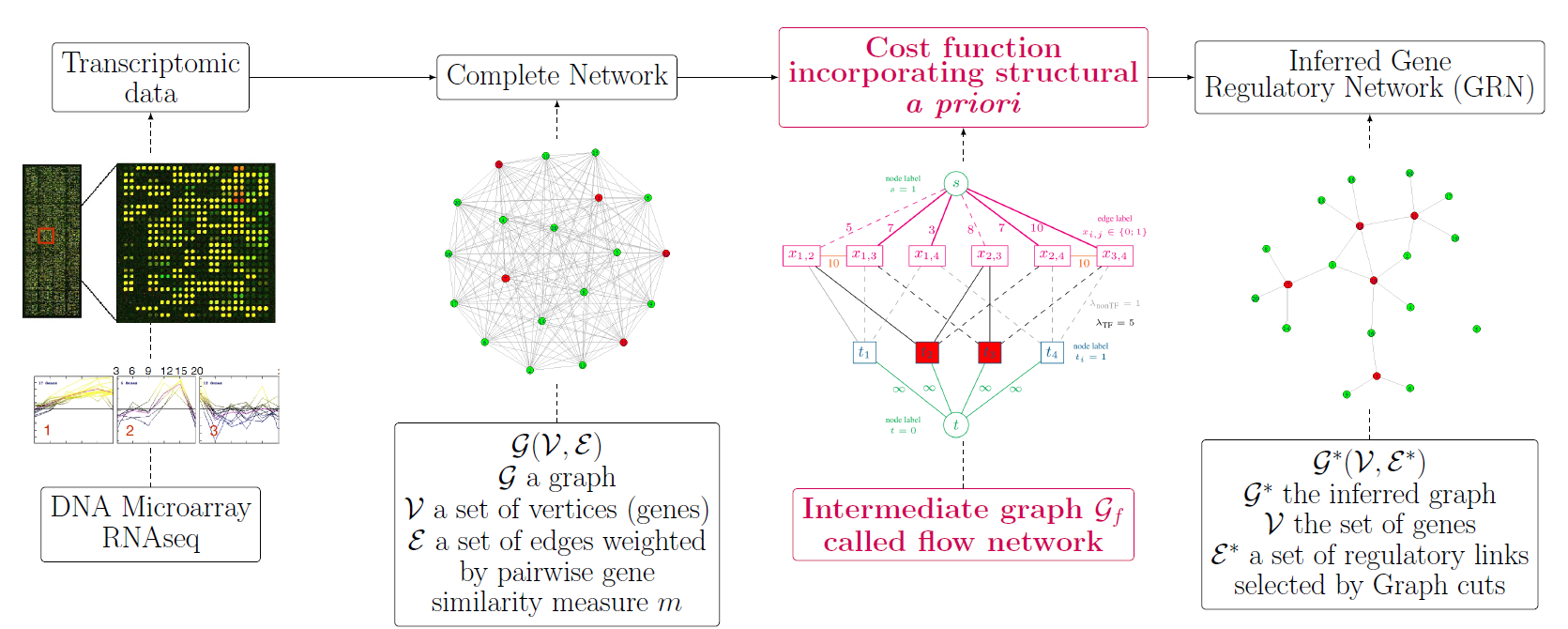
Gene regulatory networks are somehow difficult to infer. This first work from an on-going work on BRANE Omics (termed BRANE *, for Biologically Related Apriori Netwok Enhancement) introduces an optimization method (based on Graph cuts, borrowed from computer vision/image processing) to infer graphs based on biologically-related a priori (including sparsity). It is succesfully tested on DREAM challenge data and an Escherichia coli network, with a specific work to derive optimization parameters from gene network cardinality properties. And it is quite fast.


Background: Inferring gene networks from high-throughput data constitutes an important step in the discovery of relevant regulatory relationships in organism cells. Despite the large number of available Gene Regulatory Network inference methods, the problem remains challenging: the underdetermination in the space of possible solutions requires additional constraints that incorporate a priori information on gene interactions.

Methods: Weighting all possible pairwise gene relationships by a probability of edge presence, we formulate the regulatory network inference as a discrete variational problem on graphs. We enforce biologically plausible coupling between groups and types of genes by minimizing an edge labeling functional coding for a priori structures. The optimization is carried out with Graph cuts, an approach popular in image processing and computer vision. We compare the inferred regulatory networks to results achieved by the mutual-information-based Context Likelihood of Relatedness (CLR) method and by the state-of-the-art GENIE3, winner of the DREAM4 multifactorial challenge.
Results

Our BRANE Cut approach infers more accurately the five DREAM4 in silico networks (with improvements from 6 % to 11 %). On a real Escherichia coli compendium, an improvement of 11.8 % compared to CLR and 3 % compared to GENIE3 is obtained in terms of Area Under Precision-Recall curve. Up to 48 additional verified interactions are obtained over GENIE3 for a given precision. On this dataset involving 4345 genes, our method achieves a performance similar to that of GENIE3, while being more than seven times faster. The BRANE Cut code is available at: http://​www-syscom.​univ-mlv.​fr/~pirayre/Codes-GRN-BRANE-cut.html.

Conclusions: BRANE Cut is a weighted graph thresholding method. Using biologically sound penalties and data-driven parameters, it improves three state-of-the art GRN inference methods. It is applicable as a generic network inference post-processing, due to its computational efficiency.
Keywords:  Network inference, Reverse engineering, Discrete optimization, Graph cuts, Gene expression data, DREAM challenge.

Additional information of the BRANE Power page


September 29, 2014

Geophysics: Taking signal and noise to new dimensions


The journal (from SEG: Society of Exploration Geophysicists) Geophysics (SCImago journal ranking) has issued a call for papers for a special issue devoted to signal processing ("Taking signal and noise to new dimensions"), deadline end January 2015.
Original seismic stack
Large Gaussian noise corruption
Denoised with dual-tree wavelets

Taking signal and noise to new dimensions


Scope:  
The inherent complexity of seismic data has sparked, since about half a century, the development of innovative techniques to separate signal and noise. Localized time-scale representations (e. g. wavelets), parsimonious deconvolution, sparsity-promoted restoration and reconstruction are now at the core of modern signal processing and image analysis algorithms. Together with advances from computer science and machine learning, they shaped the field of data science, aiming at retrieving the inside structure of feature-rich, complex and high-dimensional datasets. This special issue is devoted to novel methodologies and strategies capable of tackling the large data volumes necessary to harness the future of subsurface exploration. A common trait resides in the possibility to seize at the same time both signal and noise properties along lower dimensional spaces, with dedicated metrics, to allow their joint use for seismic information enhancement. The traditional frontier between signal and noise is dimming, as incoherent seismic perturbations and formerly detrimental coherent wavefields, such as multiple reflections, are nowadays recognized as additional information for seismic processing, imaging and interpretation. We welcome contribution pertaining (but not limited) to:
  • emerging seismic data acquisition and management technologies
  • more compact, sparser and optimized multidimensional seismic data representations
  • filtering, noise attenuation, signal enhancement and source separation
  • advanced optimization methods and related metrics, regularizations and penalizations
  • artificial intelligence and machine learning applications for seismic data characterization
  • novel applications of signal and image processing to geophysics
  • hardware and software algorithmic breakthroughs
Timeline (tentative) for the Geophysics call of papers
  • Submission deadline: 31 Jan 2015
  • Peer review complete: 10 July 2015
  • All files submitted for production: 15 August 2015
  • Publication of issue: November-December 2015

Gravity survey @ LandTech

    June 3, 2014

    Seismic Signal Processing (ICASSP 2014)

    There was a special session on "Seismic Signal Processing" at International Conference on Acoustics, Speech and Signal Processing (ICASSP), 2014, Florence. Our talk was on simplified optimization techniques to solve multiple reflections via adaptive filtering techniques in wavelet frame domains.

    Random and structured noise both affect seismic data, hiding the reflections of interest (primaries) that carry meaningful geophysical interpretation. When the structured noise is composed of multiple reflections, its adaptive cancellation is obtained through time-varying filtering, compensating inaccuracies in given approximate templates. The under-determined problem can then be formulated as a convex optimization one, providing estimates of both filters and primaries. Within this framework, the criterion to be minimized mainly consists of two parts: a data fidelity term and hard constraints modelling a priori information. This formulation may avoid, or at least facilitate, some parameter determination tasks, usually difficult to perform in inverse problems. Not only classical constraints, such as sparsity, are considered here, but also constraints expressed through hyperplanes, onto which the projection is easy to compute. The latter constraints lead to improved performance by further constraining the space of geophysically sound solutions.
    This paper  has focused on the constrained convex formulation of adaptive multiple removal. The proposed approach, based on proximal methods, is quite flexible and allows us to integrate a large panel of hard constraints corresponding to a priori knowledge on the data to be estimated (i.e. primary signal and time-varying filters). A key observation is that some of the related constraint sets can be expressed through hyperplanes, which are not only more convenient to design, but also easier to implement through straightforward projections. Since sparsifying transforms and  constraints strongly interact [Pham-2014-TSP], we now  study the class of hyperplane constraints of interest as well as their inner parameters, together with the extension to higher dimensions

    December 17, 2013

    A Primal-Dual Proximal Algorithm for Sparse Template-Based Adaptive Filtering: Application to Seismic Multiple Removal

    A year ago we talked about a technique for Adaptive multiple subtraction with wavelet-based complex unary Wiener filters. The field of application is seismic signal processing. The fast and simple design was heuristic (helping discovery, stimulating interest as a means of furthering investigation.based on experimentation), based on an appropriate combination of "a sparsifying transform" and a closed-form one-tap, sliding-window adaptive filter. To make it more pragmatic (based on observation and real-world models), an alternative approach uses proximal algorithms to incorporate sparsity priors, either on data in redundant frame transforms and in the short-support filter design. Here is the preprint: A Primal-Dual Proximal Algorithm for Sparse Template-Based Adaptive Filtering: Application to Seismic Multiple Removal and the version published by IEEE Transactions on Signal Processing.

    Unveiling meaningful geophysical information from seismic data requires to deal with both random and structured ``noises''. As their amplitude may be greater than signals of interest (primaries), additional prior information is especially important in performing efficient signal separation. We address here the problem of multiple reflections, caused by  wave-field bouncing between layers. Since only approximate models of these phenomena are available, we propose a flexible framework for time-varying adaptive filtering of seismic signals, using sparse representations,  based on inaccurate templates. We recast the joint estimation of adaptive filters and primaries in a new convex variational formulation. This approach allows us to incorporate plausible knowledge about noise statistics, data sparsity and slow filter variation in parsimony-promoting wavelet frames.  The designed primal-dual algorithm solves a  constrained  minimization problem that alleviates standard regularization issues in finding hyperparameters. The approach demonstrates  significantly good performance in low signal-to-noise ratio conditions, both for simulated and real field data.
    While applied here to seismic signal, the concept is heavily related to pattern matching in images, echo cancellation in audio or voice signals, exemplar search in speech.

    Film-opéra-concert Ariodante

      #Ariodante de #Händel par les Arts Florissants  en opéra-concert-film est #amazing ; trois raisons, deux futiles.  c'est 16 euros, ...