 There might be a feeling of complexity in the burgeoning world of wavelets. A relatively general multiresolution framework, entitled MIMOlet (mee-moh-let), has been proposed by Guillaume Flanders et al, with a french-dutch-belgian team originating form Lille university. This scheme includes most of the known forms of discrete filter banks, critical or overcomplete, separable or directional. It borrows its name from MIMO (multi-input, multi-output) systems. More details to be found at this page (broken link at the time of writing). Its extension to the sphere (Booldelill et al.) is in progress, as a generalization to needlets (see for instance here).
March 31, 2009
WITS: MIMOlet wavelets
There might be a feeling of complexity in the burgeoning world of wavelets. A relatively general multiresolution framework, entitled MIMOlet (mee-moh-let), has been proposed by Guillaume Flanders et al, with a french-dutch-belgian team originating form Lille university. This scheme includes most of the known forms of discrete filter banks, critical or overcomplete, separable or directional. It borrows its name from MIMO (multi-input, multi-output) systems. More details to be found at this page (broken link at the time of writing). Its extension to the sphere (Booldelill et al.) is in progress, as a generalization to needlets (see for instance here).

February 13, 2009
Valentimes: The Great Gig in the Syzygy (Epoch Times),
 The magic number 1234567890 (in epoch time) will occur in a few minutes, seconds (out) elapsed since the 00:00:00 UTC on January 1, 1970 fake Unix Genesis. The 1234567890 day coincides with Valentimes. Base 10 is not the handiest, so is 1234567890 as dull a number as 1729 (see the 1729 Dullness Hardy/Ramanujan anecdote)? Not. 1234567890 + 1 is prime, so is 1234567890^2 + 1.
Eventually, the countdown buzzword drives us to the following assertion:
One hour from now, another species of life form will disappear off the face of the planet forever...and the rate is acceleratingWe will talk about that later, on January 19, 2038 (2^31 = 2147483647 overflow)
February 10, 2009
WITS: wavelet training, re-learning and writing (cfp)
 On today's WITS the wavelet winter school goes back to Le Creusot, a wavelet and time-frequency training (continuous education type) and a wavelet (multirate and multiscale) call for papers.
L'Ecole analyse multirésolution pour l'image (école de printemps) goes back to Le Creusot, from 16 to 18 March 2009, registrations open until March 5th. The objectives are the following:
L’analyse multirésolution est certainement la déclinaison la plus spectaculaire de la théorie générale des ondelettes, tant par son efficacité à représenter l’information que par sa cohérence entre signaux discrets et signaux continus. Cette école vous fera découvrir cet outil particulièrement utile et fondateur, ainsi que sa richesse et son potentiel. Vous seront proposés:A four days continuing education session (ELS043) on wavelets and related time-frequency transforms is proposed at EUROSAE (Paris) from 30 November to 3 December 2009, under the title: "Nouvelles méthodes de traitement des signaux - ondelettes, temps-fréquence : théorie, pratique et applications". Objectives again:
- initiation à cet outil devenu classique en traitement du signal et des images;
- présentation générale de ses innombrables applications dans la recherche, l’industrie et la vie de tous les jours !
- approfondissements sur l’outil dans les applications générales et fondamentales (représentation, interprétation, compression, protection des données, restauration, etc);
- introduction aux nouveaux concepts associés comme la parcimonie ou “sparsité” qui révolutionne actuellement le domaine des signaux discrets.
Acquérir une vision globale des différentes méthodes d'analyse de signaux et d'images dans un cadre non-stationnaire, en partant des techniques classiques basées sur la transformée de Fourier. Les transformations temps-fréquence et les décompositions en ondelettes sont mises en pratique sur des données simulées et réelles (signaux et images), permettant d'en découvrir les domaines d'application privilégiés. Elles sont mises en oeuvre en association avec des techniques d'estimation statistique adaptées.Last, but not least, a special issue on Advances in Multirate Filter Bank Structures and Multiscale Representations (cfp) of Signal Processing will celebrate a 100 years of wavelets since Alfréd Haar founding paper, within the following scope:
A century after the first outbreak of wavelets in Alfréd Haar’s thesis in 1909, and twenty years after the advent of Multiresolution Analysis, filter banks and wavelet transforms lie at the heart of many digital signal processing and communication systems. During the last thirty years, they have been the focus of tremendous theoretical advances and practical applications in a growing digital world. They are for instance present, as local linear expansions, at the core of many existing or forthcoming audio, image or video compression algorithms. Beyond standards, many exciting developments have emerged in filter banks and wavelets from the confrontation between scientists from different fields (including signal and image processing, computer science, harmonic analysis, approximation theory, statistics, bioengineering, physics,y). At their confluence, multiscale representations of data, associated with their efficient processing in a multirate manner, have unveiled tools or refreshed methods impacting the whole data management process, from acquisition to interpretation, through communications, recovery and visualization. Multirate structures naturally shelter key concepts such as the duality between redundancy and sparsity, as well as means for extracting low dimensional structures from higher ones. In image processing in particular, various extensions of wavelets provide smart linear tools for building insightful geometrical representations of natural images. The purpose of this special issue is to report on recent progresses performed and emerging trends in the domain of multirate filter banks and multiscale representations of signals and images. Answers to the challenge of handling an increasing demand of information extraction and processing from large data sets will be explored.
February 5, 2009
WITS: Bathlet wavelets
 The WITS (and the Virtue) honors today bathlets, a breed of wavelets based on a balanced weighted uncertainty approach. Colorado 7-eleven (7-11 math problem here) stores fear a Klingon-weaponed robber threatening clerks with a spiky, crescent shaped Star Trek inspired sword called bat'leth or Klingon's personal sword of honor. Since this description is only a coarse approximation, more details are to be found at The Denver Channel.
In the wavelet world, bathlets originate from the University of Bath, wavelets have been designed based on an Heisenberg uncertainty based metric balancing both their time and frequency spread. The Bath Wavelet warehouse serves both orthogonal and biorthogonal wavelet coefficients
 A handfull of Bat'leth
"Orthonormal wavelets with balanced uncertainty", DM Monro, BE Bassil and GJ Dickson, IEEE International Conference on Image Processing, 1996, Vol.2, pp.581-584 (local copy).
"Space-frequency balance in biorthogonal wavelets", DM Monro and BG Sherlock, IEEE International Conference on Image Processing, 1997, Vol.1, pp.624-627 (local copy).
Bat'leths: Sizing Your Bat'leth (for Vulcans or Klingons only)
January 15, 2009
Art is Arp - When art meets wavelets and compressive sensing
January 2009 issue (n° 106) of art magazine L'Oeil visits the atelier of François Morellet, (born Cholet, 1926). The following picture has been taken two month ago from Hans Jean Arp Museum in Strasbourg.

It is entitled "40000 carrés répartition aléatoire 50 % noir 50 % brun" (1961). Since the big picture is a little blurry, have a look at the high resolution detail (below). François Morellet (not Le Morlet). Doesn't it look like a random CS matrix, by an approximately wavelet-named guy? Or tell me this is just a coincidence, Igor...
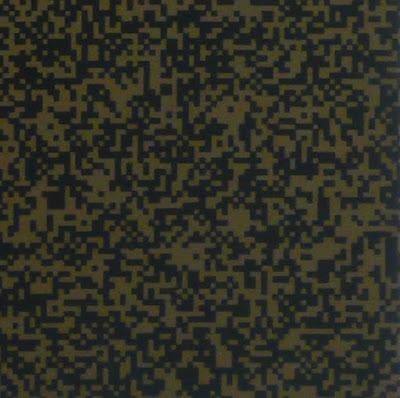

It is entitled "40000 carrés répartition aléatoire 50 % noir 50 % brun" (1961). Since the big picture is a little blurry, have a look at the high resolution detail (below). François Morellet (not Le Morlet). Doesn't it look like a random CS matrix, by an approximately wavelet-named guy? Or tell me this is just a coincidence, Igor...

January 14, 2009
December 15, 2008
Horst Tappert - That Rest Prop
Tart Prophets "Fatals Picards" have foreseen this day some time ago with their silly song "A l'enterrement de Derrick". Stephan Derrick, alias Horst Tappert, died on saturday, December 13th.
December 3, 2008
Smile in the sky - My God, it's full of stars
 Funny sign in the sky in this cold and damp December: a crescent Moon and two "stars" have just offered us a cosmic smiley. The two brilliant "stars" are our sister planets Venus and Jupiter. This smiling sky has especially being reported from the chinese side of the world, under different angles:
China economy Net
Chine informations
Lhasa: The sky smiles in the night
and last a Youtube video. Maybe a smiling sign from 2001: A Space Odyssey Star-Child, for his 20th birthday.
October 7, 2008
Major en *let - In honor of Jean Morlet
Jean Morlet (or the Major en -let, in french in the text), one of the fathers of all wavelets, along with some precursors, as in the nice notice Precursors in mathematics: early wavelet bases, by Hans G. Feichtinger, is honored at the end of October in Marseille, France.
A preliminary program below the Morelet crocodile:
 October 27 - 29th, 2008
Continuous wavelet transform and Morlet's wavelet, 1978-2008 : International colloquium in honor of Jean Morlet
Organizer: G. Saracco (CNRS, CEREGE Aix-en-Provence)
Centre International de Rencontres Mathematiques (CIRM), Campus de Luminy, Marseille, France
*Preliminary Program*:
1-Alex Grossmann: «Continuous wavelet theory and Morlet's wavelet» (Hommage à J. Morlet) , (CNRS-Evry)
2-Y. Meyer, membre de l'Académie des Sciences: «Des ondelettes continues en géophysique
aux bases orthogonales d'ondelettes» (hommage a J. Morlet) (ENS-Cahan)
3- Pierre Goupillaud : PR, Two superb mathematicians who's innovations were the product of asking question that others had overlooked. (Hommage à J. Morlet), (SEG., USA)
5-Patrick Flandrin, DR: Wavelets, surrogates and non-stationarities,(ENS-Lyon)
6-Stephane Jaffard, PR: Directional continuous wavelet transforms and application to directional smoothness of functions (Paris XII)
7-Ronald Coifman, PR: Wavelet and diffusion geometries on seismic data sets (Yale Univ., USA)
8-Alain Arneodo, DR: Surfing on the genome: a tribute to J. Morlet (ENS-Lyon)
9-Jean-Pierre Antoine: The wavelet transform on the sphere: continuous vs. discrete (Louvain, Belgique)
10-Jean-Luc Stark, : Compressed sensing in astronomy (CEA-Paris)
11-Nick Kinsbury: Complex-valued wavelets, the dual tree and the Hilbert Transform: Why these lead to
approximate shift invariance? (Cambridge Univ., GB)
12-Thierry Paul, DR: Non linear continuous wavelets and non linear coherent states (ENS-Cachan)
13-Ginette Saracco: Multi-scale tomography of buried magnetic or electrical sources: Its localization and characterization.
Application to archaeological structures or volcanic system (CNRS-CEREGE, Aix en provence)
14-Gregory Beylkin, PR: On approximation by Gaussian and its applications (Boulder Univ. Co, USA)
15-Marie Farge, DR: Continuous wavelet analysis of vortex bursting in turbulent flows (ENS-Paris)
16-Matthias Holschneider, PR, Directionnal Poisson wavelets on the sphere (Potsdam, Allemagne)
17- Jean-Claude Risset, DR emerite, medaille d'Or du CNRS, Morlet wavelet are good to hear (CNRS-LMA, Marseille)
18- Peter Frick, PR, Double Wavelet analysis: Method for recognizing stellar activity peculiarities (Moscou Russie)
19- Pascal Sailhac, From seismic wavelets to wavelet transform: using Berlage wavelets to the detection
and characterization of damped transient waves occurring in geophysical time-series", (IPG-Strasbourg)
20- Nicolas Thouveny, PR, Extraction of frequency modulation laws from Earth's magnetic field intensity records
by complex continuous wavelet analysis; contribution to understanding the geodynamo behavior. (CEREGE, Univ Aix-Marseille, Aix en Provence)
21- Say Song Goh, PR, Uncertainty Principles for the Continuous Wavelet Transform, (Rep Singapore)
22- Maurizio Fedi, Discrete and Continuous Wavelet Transform of potential fields with different choices of analyzing wavelets, (Naples Univ., Italie)
23- Roddam Narasimha, PR, Morlet Wavelets and the Solar Connection with Indian Monsoon Rainfall, (Bingalore, Inde)
24- Albert Cohen, PR, Adaptive multiresolution analysis based on anisotropic triangulations, (Univ. Pierre & Marie Curie, Paris)
25- Agissilaos Athanassoulis, Strengthening semiclassical approximations with the use of coarse-scale representations, (ENS-Ulm, Paris)
26- Nele de Shepper, Multi-dimensional continuous wavelet transforms and General Fourier transforms in Clifford Analysis, (Ghent Univ, Belgium)
Featured on the SIVA conferences web page.
A preliminary program below the Morelet crocodile:
 October 27 - 29th, 2008
Continuous wavelet transform and Morlet's wavelet, 1978-2008 : International colloquium in honor of Jean Morlet
Organizer: G. Saracco (CNRS, CEREGE Aix-en-Provence)
Centre International de Rencontres Mathematiques (CIRM), Campus de Luminy, Marseille, France
*Preliminary Program*:
1-Alex Grossmann: «Continuous wavelet theory and Morlet's wavelet» (Hommage à J. Morlet) , (CNRS-Evry)
2-Y. Meyer, membre de l'Académie des Sciences: «Des ondelettes continues en géophysique
aux bases orthogonales d'ondelettes» (hommage a J. Morlet) (ENS-Cahan)
3- Pierre Goupillaud : PR, Two superb mathematicians who's innovations were the product of asking question that others had overlooked. (Hommage à J. Morlet), (SEG., USA)
5-Patrick Flandrin, DR: Wavelets, surrogates and non-stationarities,(ENS-Lyon)
6-Stephane Jaffard, PR: Directional continuous wavelet transforms and application to directional smoothness of functions (Paris XII)
7-Ronald Coifman, PR: Wavelet and diffusion geometries on seismic data sets (Yale Univ., USA)
8-Alain Arneodo, DR: Surfing on the genome: a tribute to J. Morlet (ENS-Lyon)
9-Jean-Pierre Antoine: The wavelet transform on the sphere: continuous vs. discrete (Louvain, Belgique)
10-Jean-Luc Stark, : Compressed sensing in astronomy (CEA-Paris)
11-Nick Kinsbury: Complex-valued wavelets, the dual tree and the Hilbert Transform: Why these lead to
approximate shift invariance? (Cambridge Univ., GB)
12-Thierry Paul, DR: Non linear continuous wavelets and non linear coherent states (ENS-Cachan)
13-Ginette Saracco: Multi-scale tomography of buried magnetic or electrical sources: Its localization and characterization.
Application to archaeological structures or volcanic system (CNRS-CEREGE, Aix en provence)
14-Gregory Beylkin, PR: On approximation by Gaussian and its applications (Boulder Univ. Co, USA)
15-Marie Farge, DR: Continuous wavelet analysis of vortex bursting in turbulent flows (ENS-Paris)
16-Matthias Holschneider, PR, Directionnal Poisson wavelets on the sphere (Potsdam, Allemagne)
17- Jean-Claude Risset, DR emerite, medaille d'Or du CNRS, Morlet wavelet are good to hear (CNRS-LMA, Marseille)
18- Peter Frick, PR, Double Wavelet analysis: Method for recognizing stellar activity peculiarities (Moscou Russie)
19- Pascal Sailhac, From seismic wavelets to wavelet transform: using Berlage wavelets to the detection
and characterization of damped transient waves occurring in geophysical time-series", (IPG-Strasbourg)
20- Nicolas Thouveny, PR, Extraction of frequency modulation laws from Earth's magnetic field intensity records
by complex continuous wavelet analysis; contribution to understanding the geodynamo behavior. (CEREGE, Univ Aix-Marseille, Aix en Provence)
21- Say Song Goh, PR, Uncertainty Principles for the Continuous Wavelet Transform, (Rep Singapore)
22- Maurizio Fedi, Discrete and Continuous Wavelet Transform of potential fields with different choices of analyzing wavelets, (Naples Univ., Italie)
23- Roddam Narasimha, PR, Morlet Wavelets and the Solar Connection with Indian Monsoon Rainfall, (Bingalore, Inde)
24- Albert Cohen, PR, Adaptive multiresolution analysis based on anisotropic triangulations, (Univ. Pierre & Marie Curie, Paris)
25- Agissilaos Athanassoulis, Strengthening semiclassical approximations with the use of coarse-scale representations, (ENS-Ulm, Paris)
26- Nele de Shepper, Multi-dimensional continuous wavelet transforms and General Fourier transforms in Clifford Analysis, (Ghent Univ, Belgium)
Featured on the SIVA conferences web page.
September 27, 2008
Concern fees - Upcoming conferences - PCS 2009
The 2009 Picture Coding Symposium has been announced and its website made public
Website : PCS 2009
https://redpill.ecn.purdue.edu/~pcs2009/
Submission deadline: November 21 , 2008
Conference dates: May 6-8, 2009
Topics of interest include:
Website : PCS 2009
https://redpill.ecn.purdue.edu/~pcs2009/
Submission deadline: November 21 , 2008
Conference dates: May 6-8, 2009
Topics of interest include:
- Coding of still and moving pictures
- Content-based and object-based coding
- Scalable video coding
- Coding of multiview video and 3D graphics
- Modeling and synthetic coding
- Virtual/augmented reality and telepresence
- Coding for mobile, IP and sensor networks
- High fidelity visual data processing and coding
- Analysis for coding and adaptation
- Transcoding and transmoding
- Joint audio and visual processing and coding
- Subjective and objective quality assessment metrics and methods
- Error robustness, resilience and concealment
- Coding and indexing for database applications
- Protection and integrity of visual data
- Persistent association of information to visual data
- Joint source and channel coding
- Implementation architectures and VLSI
- New applications and techniques for visual data coding
- Standards for visual data coding
September 20, 2008
If Mike's dog really ate his frog - On the peer review origin
I originally underestimated the peer review argument in Attempts to hedge out peer review, where Eric Weinstein associates it with the "If Mike's dog really ate his frog" growing meme. In most of the scientific world, we revere pi, setting high standards to what should be published and known. Thus, let's unveil the truth: the dog's name was Bagel, which could become a peer review paradigm, as Lenna is for image processing (another Lenna tells us about a very interesting bagel and salad diet, giving us the missing link between two paradigms).
Chad Orzel quotes this anectode in Uncertain principles, with Google slightly giving it more echoes (a thought to Richard Wright by the way), as pointed out on Nuit Blanche by Igor Carron. He also refers to the soft pion theorem, but what about very cold neutrons?
Chad Orzel quotes this anectode in Uncertain principles, with Google slightly giving it more echoes (a thought to Richard Wright by the way), as pointed out on Nuit Blanche by Igor Carron. He also refers to the soft pion theorem, but what about very cold neutrons?
September 18, 2008
Concern Fees - About PIMRC 2009
Apparently, from the logs of the SIVA Conferences web page (post title anagramatic explanation), tons of radio people are looking for the next 2009 IEEE International Symposium on Personal, Indoor and Mobile Radio Communications Conference (PIMRC the 20th), which was planned in Yokohama (Japan). Luckily, PIMRC 2009 website has just been released, and holds in Tokyo (Japan again). Don't ask me why. Its 2009 theme is "Giga bit Wireless for Real Personal, Indoor and Mobile Radio Communications".
 You may look at the 20th PIMRC 2009 call for papers. The submission dead-line is 06/03/2009 (03/06/09 American style, which looks arithmetically nicer but has ambiguities), and the conference is from 16/09/2009 to 18/09/2008. Topics follow:
PHY related topics
Antenna & Propagation
Modulation & Coding
Equalization and Synchronization
MIMO
Cognitive radio
Millimeter wave
WLAN, WPAN, BAN
Enabling technologies
Beamforming antenna, MEMS, RF CMOS, etc
MAC related topics
Ad-hoc network management
Resource management
Cross-layer management
802.11/15/16 MAC
3GPP/3GPP2 MAC
Network related topics
Cognitive wireless network
Cooperative network
Ecological wireless network
P1900/802.22
Multi-hop network
Mobile agent
Wireless ad-hoc network
Sensor network
Local dependent network
Mobile computing
Mobile IP network
Application related topics
Next generation digital home network
Secure network
Wireless robotics
Social wireless networks
Security
ITS
In-car/Intra-car communications
Millimeter Giga-bit applications
Medical ICT applications
Other signal/image processing people concerned by fees should look at the Signal, Image, Video and Applications conferences page. Submissions welcome.
 You may look at the 20th PIMRC 2009 call for papers. The submission dead-line is 06/03/2009 (03/06/09 American style, which looks arithmetically nicer but has ambiguities), and the conference is from 16/09/2009 to 18/09/2008. Topics follow:
PHY related topics
Antenna & Propagation
Modulation & Coding
Equalization and Synchronization
MIMO
Cognitive radio
Millimeter wave
WLAN, WPAN, BAN
Enabling technologies
Beamforming antenna, MEMS, RF CMOS, etc
MAC related topics
Ad-hoc network management
Resource management
Cross-layer management
802.11/15/16 MAC
3GPP/3GPP2 MAC
Network related topics
Cognitive wireless network
Cooperative network
Ecological wireless network
P1900/802.22
Multi-hop network
Mobile agent
Wireless ad-hoc network
Sensor network
Local dependent network
Mobile computing
Mobile IP network
Application related topics
Next generation digital home network
Secure network
Wireless robotics
Social wireless networks
Security
ITS
In-car/Intra-car communications
Millimeter Giga-bit applications
Medical ICT applications
Other signal/image processing people concerned by fees should look at the Signal, Image, Video and Applications conferences page. Submissions welcome.
September 16, 2008
Well if Mike's dog really ate his frog, let us update
The Mike from "if Mike's dog really ate his frog" is Michael D. Grossberg. After a PhD in Mathematics from MIT, after having his dog being quoted by co-author Yael Karshon, he is apparently active in the signal/image processing community, which is... interesting to me, at least. More interesting, let us have a closer look at Mike's place: www1.cs.columbia.edu/~mdog/. Crypting writings again? No, probably a spur of Mike's Dog. But what would happen if Mike's dog really ate his blog?
September 15, 2008
What if Mike's dog really ate his frog? - On Liar's grief, faked mythologies
If Mike's dog really ate his frog is taken from a talk by Eric Weinstein: Attempts to hedge out peer review (between slides 73 and 79). It is an if and only if condition which remained long undiscovered (even if cited). It anagrams to Liar's grief, faked mythologies, which is not unrelated to its origin (cryptic writings in a PhD thesis for a student to confound his advisor). An other reference may be found at Project Euclid; just enter "ate + frog" in the fulltext search box, you get this very serious paper:
The moment map and line bundles over presymplectic toric manifolds, Yael Karshon and Susan Tolman, J. Differential Geom. Volume 38, Number 3 (1993), 465-484.
Igor Carron at Nuit Blanche suggested to meme this sentence. Let us join the mob.
P.S.: all apologies to Eric Weinstein for a name misspelling. Instead of an insincere wite (blame), to you I write incense, gold and myrrh gifts in shape of anagrams, hoping to build together irenic new ties with forgiveness, since i renew it: my apology!
The moment map and line bundles over presymplectic toric manifolds, Yael Karshon and Susan Tolman, J. Differential Geom. Volume 38, Number 3 (1993), 465-484.
Igor Carron at Nuit Blanche suggested to meme this sentence. Let us join the mob.
P.S.: all apologies to Eric Weinstein for a name misspelling. Instead of an insincere wite (blame), to you I write incense, gold and myrrh gifts in shape of anagrams, hoping to build together irenic new ties with forgiveness, since i renew it: my apology!
September 12, 2008
A real duet - On dual-tree wavelets (and a Matlab toolbox)
 True pieces of art elude science (left picture borrowed from Flickr). Anyway, dual-tree wavelets form a real duet in Hilbert transform type harmony. But the true deal comes from some software implementing this possibly complex wavelet decomposition.
Version 1.2 of the M-band dual-tree wavelet Matlab toolbox has been released. It is available from Caroline Chaux webpage or directly from the link:
http://www-syscom.univ-mlv.fr/~chaux/toolbox/TOOLBOX_DTMband1D_v1.2.zip
The toolbox implements several 2-band and M-band wavelets (e.g. Meyer 2, 3 and 4 bands, Haar, Shannon etc.) in the Hilbert transform based dual-tree wavelet framework. Theoretical results, applications and comparisons may be found in the following papers from
http://www-syscom.univ-mlv.fr/~chaux/publications.html
Image Analysis Using a Dual-Tree M-Band Wavelet Transform
IEEE Transactions on Image Processing, Vol. 15, No.8, Aug. 2006, p. 2397-2412
Noise Covariance Properties in Dual-Tree Wavelet Decompositions
IEEE Transactions on Information Theory, Vol. 53, No. 12, Dec. 2007, pp. 4680-4700.
A Nonlinear Stein Based Estimator for Multichannel Image Denoising
IEEE Transactions on Signal Processing, Vol. 56, No. 8, Aug. 2008, pp. 3855-3870.
September 2, 2008
Ice Soup - About EUSIPCO 2008 (and signal in general)

The "Signal de Sauvabelin" is a beautiful wooden tower offering a great Laussane panorama. This "signal perspective" was celebrated at the very same place in Switzerland place last week at EUSIPCO 2008. Enjoy some other pictures taken from cold Swiss lakes (hence the Ice Soup) at Picasa.
 Meanwhile, i may have another Signal Tower close to home, at La Defense (close to Paris), since Jean Nouvel recently won the contest for this renewal minded building.
Temporary exhibition of the contest's finalists at Cité Chaillot, from 25 June to 30 September 2008.
On my window by 2015. But since then, many other signal and image processing conferences will provide us with travel opportunities. The 17th European Signal Processing Conference, EUSIPCO 2009, conference will be held in Edinburgh, Scotland. An good reason to meet the 32th (Scottish) Signal Squadron? Discover the challenge, as they say. All along the watch tower, there must be some way out of here...
July 4, 2008
Concern Fees - About conferences (in signal and image processing)
Having spotted before the stricking anagrammatic link between "conferences" and "fees concern", through a digression on Juran's famous hammer and nail quote, this post initiates a series of annoucements on some upcoming signal and image processing conferences of interest since, generally, conference deadlines represent strong incentives for scientific outcomes. Due to the myriad of such events, let us consider this series, to the first order, as a self-remainder. A more complete list of signal and image processing conferences is also available.
First annoucement is SSP 2009 (IEEE Workshop on Statistical Signal Processing). It has been annouced in Cardiff, Wales, from 31/08/2009 to 03/09/2009 (present deadline: 27/04/2009).
ICA 2009 (International conference on ICA and Signal Separation) is announced in Paraty, Brazil, to be help in Spring 2009.
First annoucement is SSP 2009 (IEEE Workshop on Statistical Signal Processing). It has been annouced in Cardiff, Wales, from 31/08/2009 to 03/09/2009 (present deadline: 27/04/2009).
The theoretical topics include: Adaptive and nonlinear signal processing, Blind detection and separation, Broadband beamforming, Cognitive signal processing, Detection and estimation, Distributed signal processing, Monte Carlo methods, Multi-modal techniques, Optimization in signal processing, System identification and calibration, Time-frequency and time-scale analysis; with applications in Array processing, radar and sonar, Automotive and industrial applications, Bioinformatics and genomic signal processing, Biosignal processing and medical imaging, Communication systems and networks, Information forensics and security, Multi-dimensional signal processing, New methods, directions and applications, Sensor network.
ICA 2009 (International conference on ICA and Signal Separation) is announced in Paraty, Brazil, to be help in Spring 2009.
Independent Component Analysis and Signal Separation is one of the most exciting current areas of research in statistical signal processing and unsupervised machine learning. The area has received attention from several research communities including machine learning, neural networks, statistical signal processing and Bayesian modeling. independent Component Analysis and Signal Separation has applications at the intersection of many science and engineering disciplines concerned with understanding and extracting useful information from data as diverse as neuronal activity and brain images, bioinformatics, communications, the world wide web, audio, video, sensor signals, or time series.PCS 2009 (Picture Coding Symposium) takes places in Chicago, Illinois, USA (Purdue University) from 06/05/2009 to 08/05/2009. Deadline to be announced.
Topics of interest inculde: Coding of still and moving pictures, Content-based and object-based coding, Scalable video coding, Coding of multiview video and 3D graphics, Modeling and synthetic coding, Virtual/augmented reality and telepresence, Coding for mobile, IP and sensor networks, High fidelity visual data processing and coding, Analysis for coding and adaptation, Transcoding and transmoding, Joint audio and visual processing and coding, Subjective and objective quality assessment metrics and methods, Error robustness, resilience and concealment, Coding and indexing for database applications, Protection and integrity of visual data, Persistent association of information to visual data, Joint source and channel coding, Implementation architectures and VLSI, New applications and techniques for visual data coding, Standards for visual data coding.Last for today, ISMM 2009 (9th International Symposium on Mathematical Morphology) in Groningen, The Netherlands, deadline on 16/01/2009, to be held from 24/08/2009 to 27/08/2009. Final website unknown at the present time, first announcement here.
Gross topics: Lattice Theory, Geometry and Topology, Signal Processing, Image Processing, Connectivity, Segmentation, Machine Learning, Algorithms and Architectures, with applications.
June 12, 2008
Try nerd duel - on a fan of Tyler Durden
Let us welcome a brand new signal processing blog. Le petit chercheur illustré, under the auspices of Fight Club. If you wanna fight, Tyler Durden... Try nerd duel. Le petit chercheur deals today with some ancient form of Matching pursuit. Since its english subtitle is Yet Another Signal Processing and Applied Math blog, its acronym contains the word SPAM (for the Signal Processing and Applied Math part), enough to remind us of the Monty Python's Flying Circus.
But surprise, the whole acronym, YA SPAM, belongs to urban language, as seen in the Urban dictionary. Its definition?
Maybe someone we already knew for his "not in let multiselectivelet", a somewhat pythonesque wavelet. Very well adapted indeed. Welcome Laurent (yet another one). We hope you quickly grow into a grand chercheur illustre.
But surprise, the whole acronym, YA SPAM, belongs to urban language, as seen in the Urban dictionary. Its definition?
An quick precise reaction to an outburst of words from another person
Maybe someone we already knew for his "not in let multiselectivelet", a somewhat pythonesque wavelet. Very well adapted indeed. Welcome Laurent (yet another one). We hope you quickly grow into a grand chercheur illustre.
| | ||
May 30, 2008
Conferences (Concern Fees?) - About hammers and nails
There is some concern about scientific conferences in general, and signal/image/video conferences in particular, as money making machines (hence the fees' concern anagram). Not only places where people meet, share, even copy or steal ideas... Remember the standard quote, attributed to Wilson Mizner (1876-1933):
And now for something completely different. About 10 years ago, the department head of an engineering school asked me whether people in the industry did use wavelets? My reply was: "do you teach wavelets to future engineers?" The answer was no. Anyway, there exists a conference dealing with wavelet applications in the industry, organized by Fred Truchetet and Olivier Laligant: SPIE Wavelet Applications in Industrial Processing VI (WAIP 2009), along with SPIE Electronic Imaging in San Jose, California, USA, 16-18/01/2009. Deadline for a short abstract: 16/06/2008.
My concern above was not about wavelets or anything else. But industrial business is often time consuming, cost bounded, and people tend to reuse known tools a lot. Even for weakly related problems. The quote here is the nail/hammer famous line. Though once again, several (digital) versions co-exist; one attributed to Abraham Maslow (1908-1970), founder of humanistic psychology:
 28th), management consultant, quality guru. All these folks overlap (in time) and exhibit some redundancy (in some orthogonal direction), which are my two main signal processing concerns. Anyway my reply was about teaching concepts that could help future engineers seize new ideas when needed, to avoid pure repetition.
Another conference is GRESTI 2009 Symposium on Signal and Image Processing, to be held in Dijon, France, from 8 to 11 September 2009. Deadline 15 Feb. 2009. The last announcement for today is tentative, the Mathematical Methods for Natural Images and Textures Processing, organized by G. Peyré, J.F. Aujol and J. Fadili, at IHP, Paris, France, to be help in June 2009.
Copy from one, it's plagiarism; copy from two, it's researchor maybe this quote has also been unfaithfully copied, since it often appear as
If you steal from one author, it’s plagiarism; if you steal from many, it’s researchSteal or copy, two or many. Blame the the cut, correct and paste. Since Mizner's most famous plays is entitled The Deep Purple, shouldn't this sentence be refined along the lines of another solid rock band, Megadeth (Captive honour, from Countdown to extinction):
And when you kill a man, you're a murderer (plagiarist)What would be the research equivalent of "god"? Contributions welcome. Anyway, let us mention a few interesting conferences in signal or image processing. The upcoming EUSIPCO 2008, in Lausanne, Switzerland, along with the satellite international workshop LNLA 2008, dealing with "Local and Non-Local Approximation in Image Processing". Still waiting for the program and its novelties from the sparse or compressive sensing world.
Kill many, and you're a conqueror (researcher, then)
Kill them all... Ooh... Oh you're a god!
And now for something completely different. About 10 years ago, the department head of an engineering school asked me whether people in the industry did use wavelets? My reply was: "do you teach wavelets to future engineers?" The answer was no. Anyway, there exists a conference dealing with wavelet applications in the industry, organized by Fred Truchetet and Olivier Laligant: SPIE Wavelet Applications in Industrial Processing VI (WAIP 2009), along with SPIE Electronic Imaging in San Jose, California, USA, 16-18/01/2009. Deadline for a short abstract: 16/06/2008.
My concern above was not about wavelets or anything else. But industrial business is often time consuming, cost bounded, and people tend to reuse known tools a lot. Even for weakly related problems. The quote here is the nail/hammer famous line. Though once again, several (digital) versions co-exist; one attributed to Abraham Maslow (1908-1970), founder of humanistic psychology:
If you only have a hammer, you tend to see every problem as a nailor this one, copied from his book "Psychology of Science":
I suppose it is tempting, if the only tool you have is a hammer, to treat everything as if it were a nailApparently, this idea is good enough to have been used by several persons. Maslow's is said to originate from his mentor Michael Polanyi (1891-1976), while Bernard Baruch (1870-1965) is credited with
If all you have is a hammer, everything looks like a nailThe only one i have been aware of before the world wide web was (in French)
Quand on n'a qu'un marteau dans sa boîte à outils, tous les problèmes ont la forme d'un cloufrom a guy simply known as Juran. Which could be translated as:
When you only have a hammer in your toolbox, all your problems are nail-shapedIt might be Joseph M. Juran (1904-2008, he just died on February
 28th), management consultant, quality guru. All these folks overlap (in time) and exhibit some redundancy (in some orthogonal direction), which are my two main signal processing concerns. Anyway my reply was about teaching concepts that could help future engineers seize new ideas when needed, to avoid pure repetition.
Another conference is GRESTI 2009 Symposium on Signal and Image Processing, to be held in Dijon, France, from 8 to 11 September 2009. Deadline 15 Feb. 2009. The last announcement for today is tentative, the Mathematical Methods for Natural Images and Textures Processing, organized by G. Peyré, J.F. Aujol and J. Fadili, at IHP, Paris, France, to be help in June 2009.
May 7, 2008
Swanky Bettors - on West bank Story
May a movie bring some peace in the Middle East? A litte singing, a little dancing, a lot of humm(our)us. A nice feature for this 60th anniversary of the Foundation of the state of Israel.
 Swanky Bettors may bet on West bank Story (online video here, and IMDB page there) by Ari Sandel. Official selection of the 2005 Sundance film fest, 28 prizes won in festivals. Love inside inter-family confrontation in a FFF (falafel-fast-food, not FFF, not FFF) world, KK (Kosher-King) against HH (Hummus Hut). David and Fatima replay Romeo and Juliet and West side story. Wanna trade chickpeas for a chic peace?
 Swanky Bettors may bet on West bank Story (online video here, and IMDB page there) by Ari Sandel. Official selection of the 2005 Sundance film fest, 28 prizes won in festivals. Love inside inter-family confrontation in a FFF (falafel-fast-food, not FFF, not FFF) world, KK (Kosher-King) against HH (Hummus Hut). David and Fatima replay Romeo and Juliet and West side story. Wanna trade chickpeas for a chic peace?
Subscribe to:
Posts (Atom)
Film-opéra-concert Ariodante
#Ariodante de #Händel par les Arts Florissants en opéra-concert-film est #amazing ; trois raisons, deux futiles. c'est 16 euros, ...
-
#Ariodante de #Händel par les Arts Florissants en opéra-concert-film est #amazing ; trois raisons, deux futiles. c'est 16 euros, ...
-
 Essentials: BEADS paper : Baseline Estimation And Denoising w/ Sparsity BEADS Matlab toolbox BEADS Baseline toolbox at MatlabCentral ...
 -
Kernel clustering [Modern transcription of the Hugo Steinhaus paper in 1956 (in French) , at the source of k-means clustering algorith...

